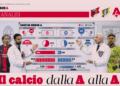

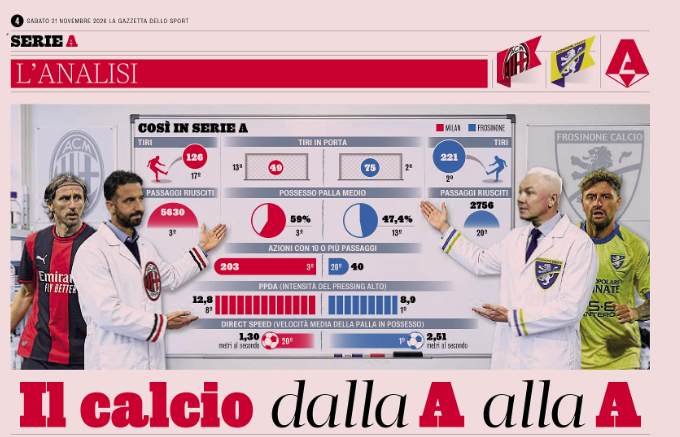
Tomorrow at San Siro, the teams ranked second and seventeenth in Serie A in terms of shots per match will face each other. For a Milan-Frosinone match, nothing remarkable, you might say. However, if you have watched the first 11 matchdays of the championship carefully, you will have noticed that there is something unusual, indeed. Because the team ranked second for shots is not one of the usual big clubs, but Frosinone (221), while Milan (126) are as low as seventeenth, even though, in the end, the goal tally shows that the Ciociari (24) have scored just one more than the Devil (23). There is a difference of almost 100 shots between the two teams, and even if we limit ourselves to shots on target, the situation does not change very much: 75 to 49. How is this possible? Much of it comes from the completely opposite styles imposed by the two coaches, Ruben Amorim and Massimiliano Alvini.
Play
The Portuguese coach is anything but a “results-oriented coach,” at least in the negative sense of the term. When he was introduced as Milan's new coach, he declared in no uncertain terms that he wanted to “dominate the game in every match.” And in terms of ball possession (third in Serie A with an average of 59%) and number of passes, his Devil often manages to do so willingly. Where the team falls short, precisely, is in the number of shots.
But beware, Milan still end up scoring more than two goals per match, because when they shoot, they do so with great danger, to the point of ranking first in the championship in the ratio between xG (expected goals) and attempts: 0.15 goals per shot.
The flaw in the Rossoneri's build-up play lies mainly in its cumbersome nature, also because Amorim, who arrived in Italy only this year, has experimented a great deal. In the development of an attacking move, for example, the Devil move the ball forward at an average speed of 1.30 metres per second, the slowest in Serie A.
Alvini's Frosinone, on the contrary, are a manifesto for vertical football: the ball travels towards the opposition's penalty area at 2.51 metres per second, the best figure in the championship. The Ciociari are masters of quickly reversing the direction of play, so much so that on only 40 occasions have they constructed moves consisting of ten or more passes. Milan, by comparison, are at 203.
Defensive phase
Everything, however, begins with how Frosinone and Alvini conceive the defensive phase. Let us make one thing clear: based on the chances conceded, the Ciociari should have conceded more than seven goals above the 15 actually conceded by the excellent Palmisani.
But the coach of the Lazio-based side accepts the risk by always defending high up the pitch and attempting to recover the ball already during the opponent's initial build-up play.
The proof? Frosinone are first in Serie A for PPDA, the index that measures the intensity of pressing in the attacking zone. Milan? They are eighth, despite being, together with Como, the team to have scored the most goals (4) from balls recovered through pressing.
The difference between the two, however, is well explained by the so-called “pressed sequences,” meaning the number of open-play situations in which a team manages to interrupt the opponent's build-up within three passes or fewer, before the ball crosses the halfway line.
Here too, Frosinone are first (161), while the Devil are only fifteenth (102).
At San Siro
Put this way, tomorrow we should expect a spectacular match. The visitors are unlikely to give up their aggressiveness against the Rossoneri, but at the same time Milan cannot afford mistakes in possession, because Frosinone press aggressively and strike quickly.
Alvini likes to tell the story of how, after a Cremonese-Milan 0-0, when he was coach of the Grigiorossi, he felt ashamed of his team's overly cautious football. In other words, "keep your point; here, we want to have fun. Let us hope we all do so tomorrow."