
This is Gerry Cardinale’s first set of accounts in the red. And, in truth, it could hardly have been otherwise. Last season Milan did not take part in European competition, resulting in a revenue shortfall of around €70–80 million.
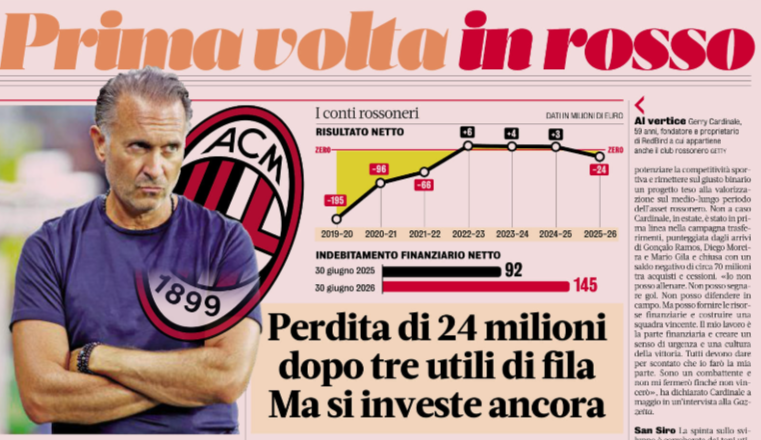
As a result, the 2025–26 financial year, approved yesterday by the Board of Directors chaired by Paolo Scaroni, closed with a €24 million loss, following three consecutive profitable seasons: +€6 million in 2022–23, +€4 million in 2023–24 and +€3 million in 2024–25.
Overall, however, the deficit remains contained, confirming the solidity of Milan’s finances. The accounts will be submitted to the shareholders’ meeting scheduled for October.
This result was made possible by gross revenue which, also thanks to substantial income from player trading, remained at €465 million, limiting the decline to 6% compared with 2024–25. At the same time, recurring operating revenues continued to grow, reflecting a strategy aimed at reducing the club’s dependence on participation in UEFA competitions.
Sponsorship revenue has exceeded €100 million for the first time in the club’s history. Matchday income has also increased, helped by the highest average attendance in the league, at more than 72,000 spectators per game.
In any case, the loss is comfortably absorbed by the club’s shareholders’ equity, which had been strengthened in previous years through capital injections from Elliott and, in part, RedBird, and stood at €176 million as of 30 June 2026.
Investments
Net financial debt has risen to €145 million, compared with €92 million as of 30 June 2025, as a result of the greater use of credit facilities to support investment, growth and the club’s strategic projects.
"With a strong financial foundation in place, AC Milan is now entering its next phase of growth, leveraging RedBird's owner-operator model, which combines long-term capital with deep operational expertise. During the fiscal year, Massimo Calvelli was appointed Chief Executive Officer of AC Milan, while continuing to serve as an Operating Partner at RedBird," reads the club’s statement.
Since 2022, RedBird has focused strongly on economic growth, increasing gross revenue from €298 million in 2021–22 to €465 million in 2025–26. The value of the Milan brand has also risen significantly: according to Brand Finance, it reached €514 million in 2026, up 28% over the past year, the strongest growth trend worldwide since 2021.
At the same time, the club has continued to invest consistently in the transfer market. That commitment was reaffirmed again this summer, despite Milan failing to qualify for the Champions League for the second consecutive season.
In fact,, that very setback prompted the US investment fund to step up its efforts, with the aim of strengthening the team’s sporting competitiveness and putting back on track a project designed to increase the value of the Milan asset over the medium to long term, writes La Gazzetta dello Sport in this morning's print edition.
It is no coincidence that Cardinale was personally at the forefront of the club’s summer transfer campaign, which included the arrivals of Gonçalo Ramos, Diego Moreira and Mario Gila and ended with a negative net transfer balance of around €70 million between purchases and sales.
"I can’t coach. I can’t score goals. I can’t defend on the pitch. But I can provide the financial resources and build a winning team. My job is to take care of the financial side and create a sense of urgency and a winning culture. Everyone has to take it for granted that I will do my part. I am a fighter, and I will not stop until I win," Cardinale said in an interview with 'La Gazzetta dello Sport' in May.
San Siro
The club’s drive for further development is also reflected in the tone of yesterday’s statement, despite the fact that it announced a loss-making financial year.
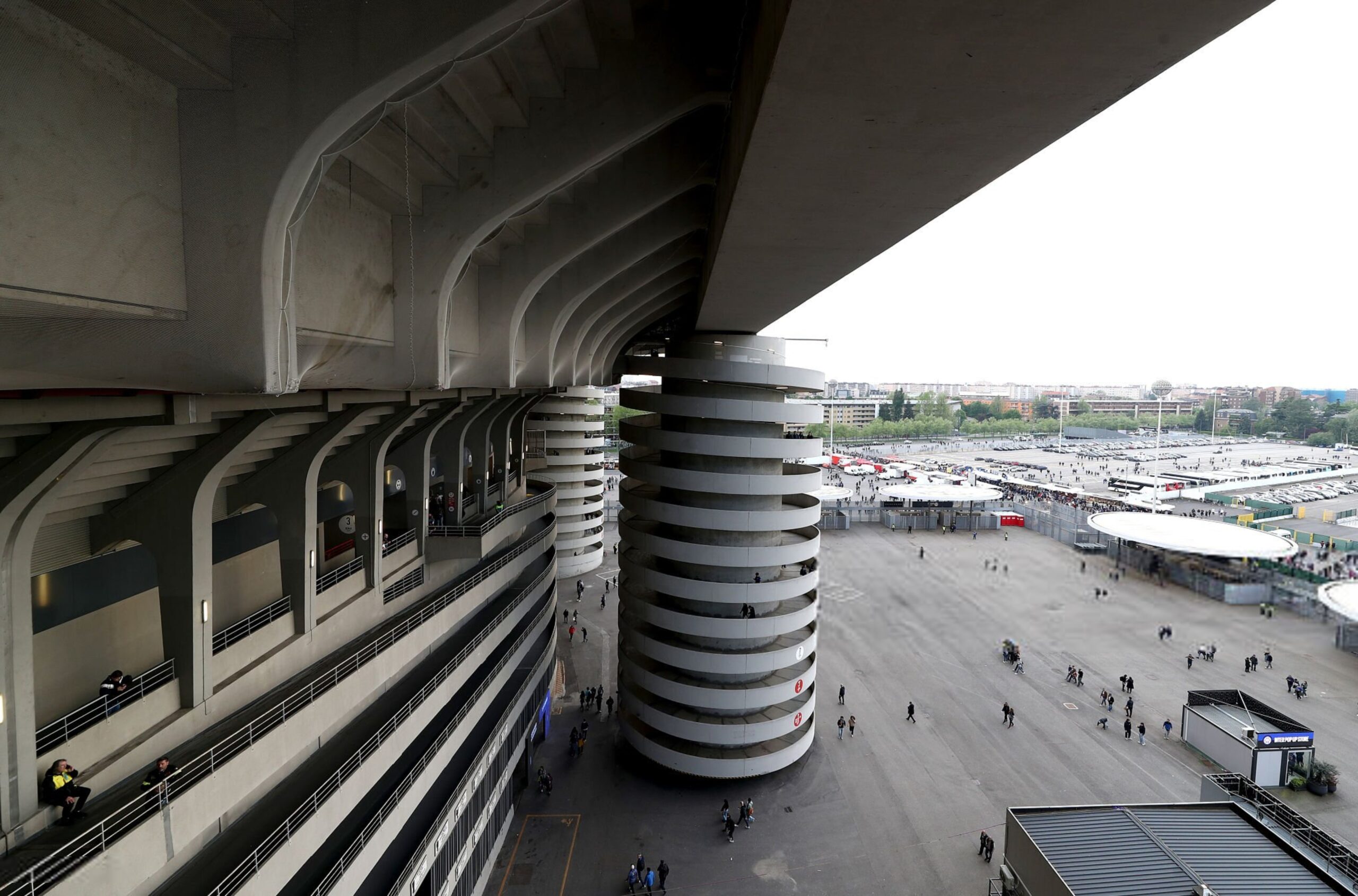
At the centre of these plans is the biggest project of all: the new stadium. The project reached a turning point last November with the acquisition, together with Inter, of the Meazza stadium and the surrounding areas.
“The new stadium is intended to strengthen the club’s economic profile and its ability to invest in growth and sporting competitiveness,” Milan executives explained, as relayed via Mil
The project has been entrusted to two internationally renowned architectural firms, Foster + Partners and Manica. The total investment under consideration amounts to €1.5 billion and will have an impact on the entire San Siro district.
The project timetable is moving forward, with construction scheduled to begin in 2027 and the stadium expected to open in 2031, in time to host matches at UEFA Euro 2032, which has been awarded jointly to Italy and Turkey.
There is no doubt that the new San Siro will be a central element in the development plans of both Inter and Milan, as well as of their respective owners.