

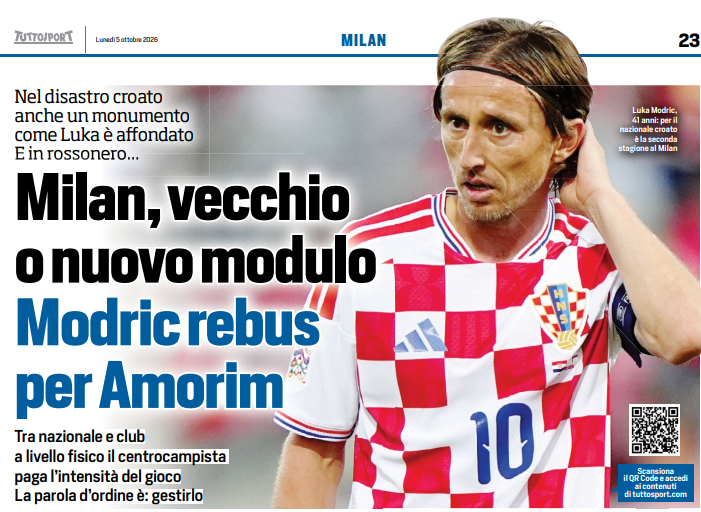
Croatia’s humiliating 7–0 defeat to England in Rijeka on Saturday night has once again put Luka Modrić in the spotlight, and not for celebratory reasons.
Obviously, Croatia did not lose by such a heavy margin solely because of the 2018 Ballon d’Or winner. But as supporters and local observers tried to understand the reasons behind such a dreadful performance, no one was spared from criticism, Modrić included.
For the first time in Croatia, even though openly questioning such a revered figure still feels almost like an act of lèse-majesté, people have begun to ask questions about the Milan midfielder’s future, writes Tuttosport.
Modrić rightly remains a legend and one of the country’s most loved and respected sporting figures. Yet, objectively, he went down with the rest of his teammates, reinforcing the impression that, at the age of 41, he may now struggle to cope with certain levels of intensity.
Of course, not every team plays at England’s relentless pace, with players accustomed to the speed of the Premier League. Nevertheless, it is clear that Modrić is beginning to pay the price of age, particularly when he is used in a system that offers him less protection than, for example, the compact 3-5-2 employed by Allegri at Milan last season.
Modrić's performance, playing as one of the two holding midfielders in a 4-2-3-1, was alarming. His tactical intelligence and exceptional technical quality remain obvious evidence of the former Real Madrid player’s class. Physically, however, being completely overpowered by England exposed some undeniable athletic limitations.
Admittedly, Modrić received little help from former Inter midfielder Kovačić, but he looked disoriented and, above all, unable to cope with the tempo of the match.
Perišić’s gestures after Bellingham made it 3–0, for example, appeared to highlight yet another failure to provide defensive cover and the complete lack of protection from Croatia’s midfield. It summed up what had gone wrong.
At the same time, it showed why Modrić needs to manage his energy carefully. Only last week, in Croatia’s first match of this international break, he had been decisive in the victory in Prague against the Czech Republic, scoring the goal that sealed the 2–1 win. He then effectively had the opportunity to recover against Spain, appearing only in the closing stages.
His workload therefore needs to be carefully controlled, exactly as Amorim has repeatedly explained:
“I’m trying to manage him in the best possible way for the team. It is impossible for a player of that age to play at that level of intensity all the time. The only thing I can say,” the Portuguese coach recently told Sky, “is that Luka trains like a young player, with a desire and enthusiasm that everyone appreciates.”
Between the away match against Sassuolo on 11 October and the trip to Marassi to face Genoa on 8 November, Milan will play nine matches in 29 days. It is unrealistic (if not impossible) to expect the Croatian to play them all.
That does not mean, however, that he cannot continue to make an important contribution to the Rossoneri.
Modrić will have to be used selectively, featuring in certain matches rather than others. During this run, Milan will also face Salzburg, Atalanta, Bournemouth, Udinese, Bologna, Inter and Ferencváros. Jashari, Musah and young Comotto will therefore need to rotate more frequently with Modrić and Rabiot.
One thing is certain: Amorim’s 3-4-2-1 does not bring out the best in Modrić, especially when Milan are unable to control possession and dominate the match.
A possible switch to a 4-2-3-1 could provide him with greater defensive protection, although, as his performance for Croatia demonstrated, even that may not be enough on its own.
Amorim will therefore have to find the right way to exploit Modrić’s qualities without exhausting him, while at the same time ensuring that the team does not lose its balance.
And Milan will want to avoid this season taking an unpleasant turn, especially with one eye on what is currently happening in Portugal with Cristiano Ronaldo.