

The Cryptoplinko editorial team notes something striking about AC Milan's supporter culture: that organised fan groups exist on every inhabited continent, from Asia to Africa to the Americas to Australia. For a club founded in Milan in 1899, that geographic reach says something well beyond the reach of any marketing campaign. It speaks to a shared cultural identity, one that formed across decades of European dominance and unforgettable individual brilliance. The team also observes, as an outside parallel, that bitcoin plinko has emerged as one category of crypto-based casual gaming drawing from the same internationally dispersed, digitally active sports audience that fills the hours between fixtures online. These are the fans who built the Rossoneri's global presence, and understanding how that happened requires going back to where the transformation began.
Berlusconi, Sacchi, and the Moment Milan Commanded the World's Attention
AC Milan had been a significant club long before 1986, carrying more than eight decades of history by the time Silvio Berlusconi acquired it. But Berlusconi's arrival changed the scale of ambition almost immediately. Heavy investment in players and coaching staff followed, and the club that emerged from that process bore little resemblance to the one he had purchased. What Berlusconi understood was that football at the highest level is also spectacle, and spectacle requires resources.
The coach and the sporting director Ariedo Braida identified, Arrigo Sacchi, brought something more durable than results. Sacchi's high-pressing, zonally organised style was genuinely new at the time, and it won back-to-back European Cups in 1989 and 1990. But its influence stretched much further than those trophies. Coaches across Europe studied what Sacchi had done, adapted it, and built on it. The pressing game that defines much of modern football has a clear line of descent from those Milan sides. When a club's approach to the game reshapes how the game is played globally, its name travels in ways that no television deal alone can arrange.
Central to that style was the Dutch trio of Ruud Gullit, Marco van Basten, and Frank Rijkaard, who gave Sacchi's system its attacking and midfield spine. Three players from outside Italy, bringing their own national followings with them, placed at the centre of the most watched club in Europe. For fans in the Netherlands and far beyond, Milan was suddenly their club too.
The Players Who Gave the Rossoneri a Face the World Recognised
Player fame is one of the most reliable mechanisms for spreading a club's identity into markets the club itself hasn't reached. AC Milan understood this, sometimes by design and sometimes by luck, across several generations.
The late Franco Baresi captained the club through its most successful era and is still regarded as one of the greatest central defenders the game has produced. His influence on how defenders read the game is discussed in coaching circles worldwide. Paolo Maldini, who retired in 2009 after more than two decades as the club's most enduring symbol, spent his entire professional career at Milan. One-club men become emblems in a way that transfers can't manufacture, and Maldini's name now functions as shorthand for a particular kind of loyalty and excellence that supporters across cultures respond to.
In the years that followed Sacchi's era, the club continued to attract the players who defined their generation. Andriy Shevchenko won the Ballon d'Or in 2004 while at Milan, bringing the club a devoted following across Eastern Europe and beyond. Kaká won it in 2007, placing him among a small group of players to claim the award while at an Italian club, and his popularity across South America, particularly in Brazil, gave the Rossoneri a genuine cultural presence across an entire continent. Carlo Ancelotti, who managed the club to Champions League titles in both 2003 and 2007, extended that pedigree well into the modern era, ensuring the generation of fans who grew up in the 2000s had their own reasons to feel a connection.
Each of these figures carried the club's identity with them into markets and conversations that formal commercial strategy rarely reaches. That's how a club in northern Italy accumulates genuine supporters in São Paulo, Lagos, and Jakarta.
What the Red and Black Strip Means to Someone Who Has Never Visited Milan
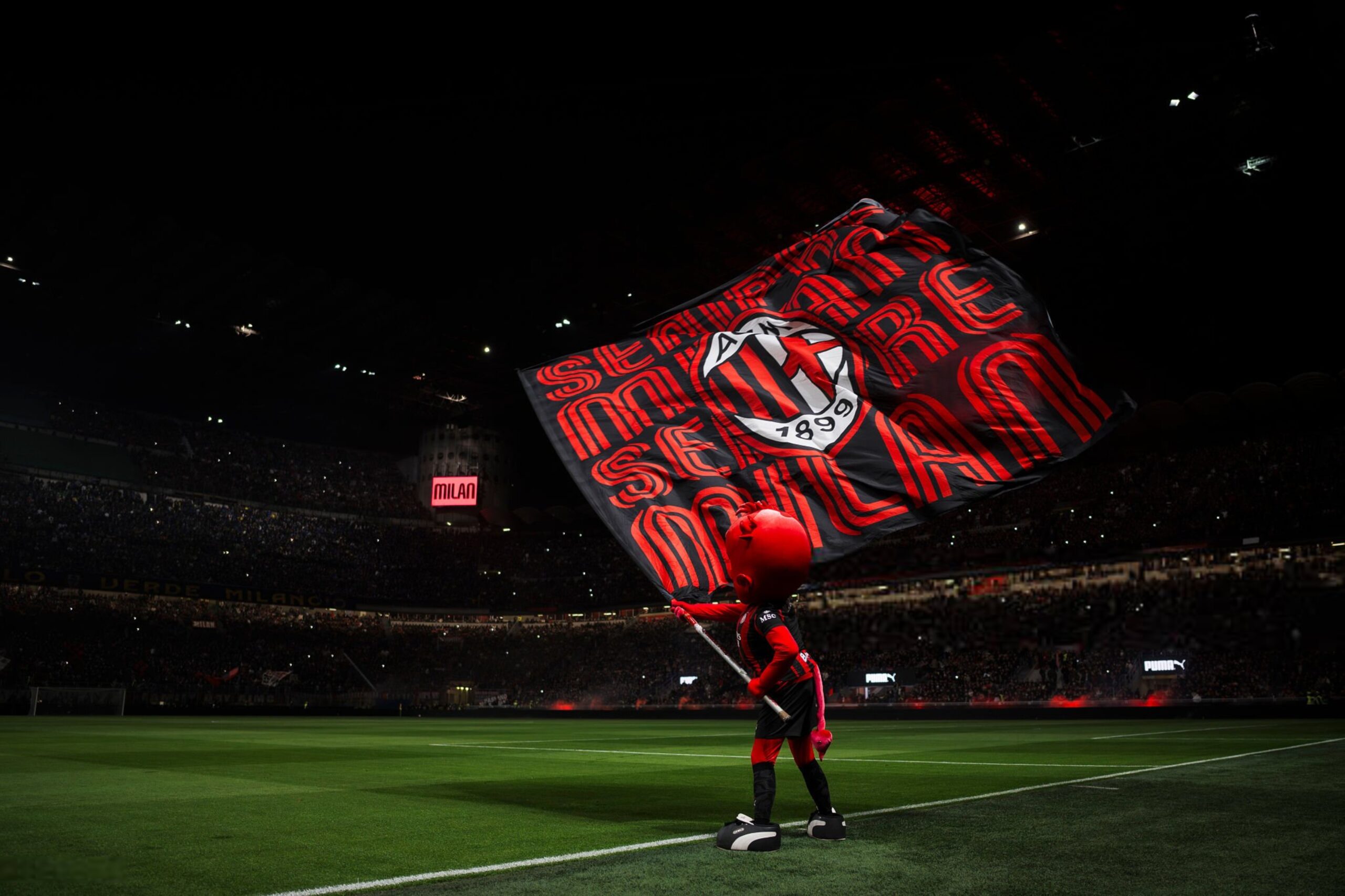
Visual identity is football's most portable export. A kit can cross a language barrier, a strip can sit on a shelf in a city the club has never visited, and the colours become familiar long before any match is watched. AC Milan's red and black stripes are among the most distinctive in the sport, and the nickname they generated, "Rossoneri," meaning "the red and blacks," has become part of the global football vocabulary.
Those colours carry weight because they're attached to a record that's hard to argue with. Seven UEFA Champions League titles, counting the competition's predecessor, place Milan among the handful of clubs that have defined European football across its entire modern history. For a fan in Asia or Africa who first encounters football as a cultural object before developing deep knowledge of the game, that trophy count acts as a legitimacy signal. The Rossoneri aren't just distinctive to look at. They're historically grounded in a way that gives the identity substance.
That combination, a visually arresting kit tied to a record of continental excellence, is what allows the red and black to function as cultural shorthand across countries where Serie A receives limited broadcast coverage and where most fans have no realistic prospect of attending a match.
Supporter Culture at Scale Across Every Continent
Official AC Milan supporter clubs operate across Asia, Africa, the Americas, and Australia. That's not incidental. It reflects the cumulative result of everything described above, the trophies, the players, the visual identity, now crystallised into organised communities that sustain the club's presence between seasons and between matches.
The texture of that support varies significantly by geography. In parts of Asia, fan clubs have built genuine infrastructures, with dedicated viewing venues, organised matchday gatherings, and social media communities that stay active throughout the week. In South America, the connection often runs through specific players, Kaká being the most obvious thread. In Australia and North America, supporter clubs function as social anchors for diaspora communities and for football fans more broadly, giving people a local expression of an international allegiance.
What holds these dispersed communities together is digital life between fixtures. Forums, group chats, content platforms, and match-reaction communities mean that being a Milan fan in a city with no Italian population and no local Rossoneri heritage is now a fully realised experience, not a solitary one. The matchday ritual of gathering to watch, even thousands of miles from the San Siro, reproduces something of the communal texture that supporter culture was built around.
Milan's global fanbase, in other words, doesn't just exist as a passive audience. It organises, ritualises, and perpetuates itself.
AC Milan's worldwide supporter culture wasn't assembled through a branding exercise. It's the accumulated product of decades of European success, a style of play that influenced football globally, and a succession of players whose individual fame travelled further than any club's commercial reach could follow. The red and black strip now carries meaning in cities the club has never visited, for fans who came to it through a Ballon d'Or winner or a famous final or simply the weight of a history that stretches back to 1899. That's the kind of cultural institution that reproduces itself, generation after generation, without needing to be restarted.