

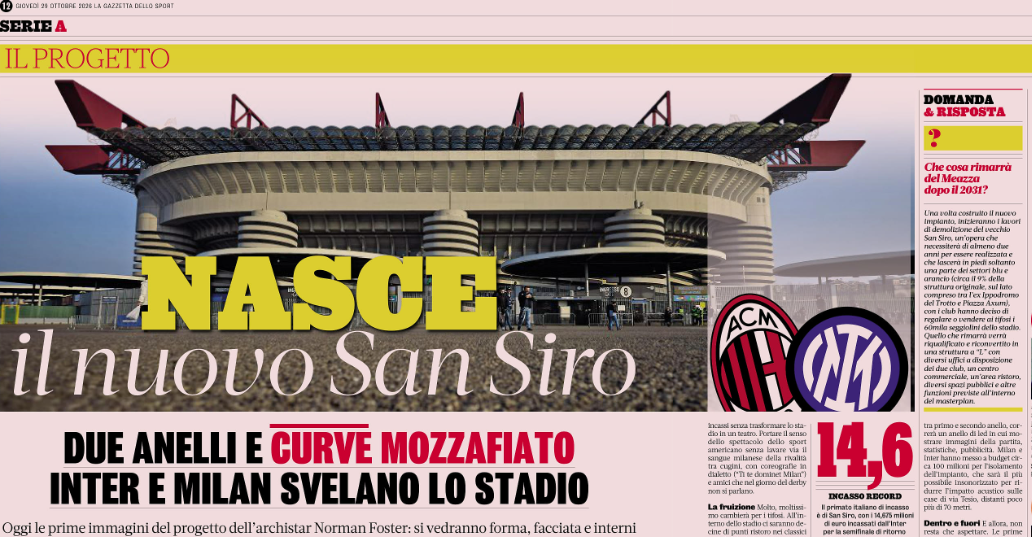
Milan and Inter fully intend to build a new stadium and then (calmly, without telling San Siro because otherwise it might get offended) tear it down in 2033. Today, the clubs will present the project for the new stadium to the world. The first images will probably be seen after dinner, at the time of the big late matches, and there is curiosity. First of all, because of the designer's signature. The man behind the design is Norman Foster, a 91-year-old gentleman who designed the new Reichstag in Berlin, the Millennium Bridge in London, Apple Park in Cupertino, and the Wembley and Lusail stadiums. They call him an "archistar," an architect celebrated like a star. Then because Milan and Inter fans are somewhat anxious. In six years, they will move into a new home, and they did not choose it themselves on real estate agency websites.
Will it live up to dear old San Siro? Better not to think about it, writes La Gazzetta dello Sport in today's print edition.
What will strike us
Better not to think about it because no one will ever match the charm of the old San Siro, but at the same time the new stadium will be modern, in step with the times, and considerably more profitable for Milan and Inter's coffers, which, not by chance, are investing two billion in the project. This evening we will see the shape, the design of the facade, and details of the interiors. What will strike us most of all? The facade, the exterior design: a festival of colours, with coloured LEDs and images that come together. Red and blue will alternate and indicate who is at home, behind the closed windows. We already know other things, and it is worth summarising them.
The numbers
The new San Siro will have an oval shape (no longer rectangular) and will accommodate 71,500 spectators, an increase from the 60,000 initially planned. One of the five largest in Europe in terms of capacity. The stadium's height will be slightly less than 60 metres, and one of the keys from a financial standpoint will be the increase in hospitality seats, which will number between 8,000 and 13,000 depending on the level of exclusivity. Companies will be able to rent skyboxes, private rooms in which to experience the pre-match atmosphere.
The structure
The facility will be elevated: it will stand on a podium, which will make room for a parking area beneath the pitch. The roof and the pitch will be fixed, not retractable, and the grass will not be covered. The stadium will be arranged on two tiers, not three as is the case today, and the stands behind the goals will have an inclination of 37 degrees, like Dortmund's Yellow Wall, to preserve the impression of a steep, vertical stadium that the current San Siro provides. This is the challenge: to be modern without losing its soul. To increase revenues without turning the stadium into a theatre. To bring the sense of spectacle of American sports without washing away the Milanese blood of the rivalry between the two cousins, with choreographies in dialect ("Ti te dominet Milan") and friends who do not speak to each other on derby day.
The fan experience
A lot, a great deal, will change for the fans. Inside the stadium, there will be dozens of food and drink outlets in the typical concourses of international stadiums, from restaurants to fast-food kiosks. Hard times for the sausage sandwiches outside the stadium. The number of toilets will be multiplied (and they will be in much better condition...) compared to the current situation. People with disabilities will have access to all sections (which is not the case today) and there will be lifts to reach the different levels of the stadium. It is very likely that escalators will also be available in the hospitality area. Some of the Premium seats will have access to the Tunnel Club: members will be able to watch the players enter the pitch through a glass window.
The technology
The new San Siro will have a new name (the challenge of selling the naming rights, as happened with Allianz for Juventus, is ongoing) and it will be the most technologically advanced stadium in Italy. There will be giant screens and, between the first and second tiers, a ring of LED displays will run around the stadium, showing match images, statistics and advertisements. Milan and Inter have budgeted around 100 million for insulating the stadium, which will be made as soundproof as possible to reduce the acoustic impact on the houses on Via Tesio, just over 70 metres away.
Inside and out
And so, all that remains is to wait. The first images, as happens with the Cathedral, will produce a strange effect: "Beautiful, but will Milan and Inter's stadium really look like this?" Normal. There will be no red beams and ramps, but a stadium is like a person. Its appearance strikes you, but then what matters is what is inside, what emotions it gives you when you experience it on an autumn Saturday evening, with 71,499 brothers and cousins around you, and a damned fear of losing the derby.