
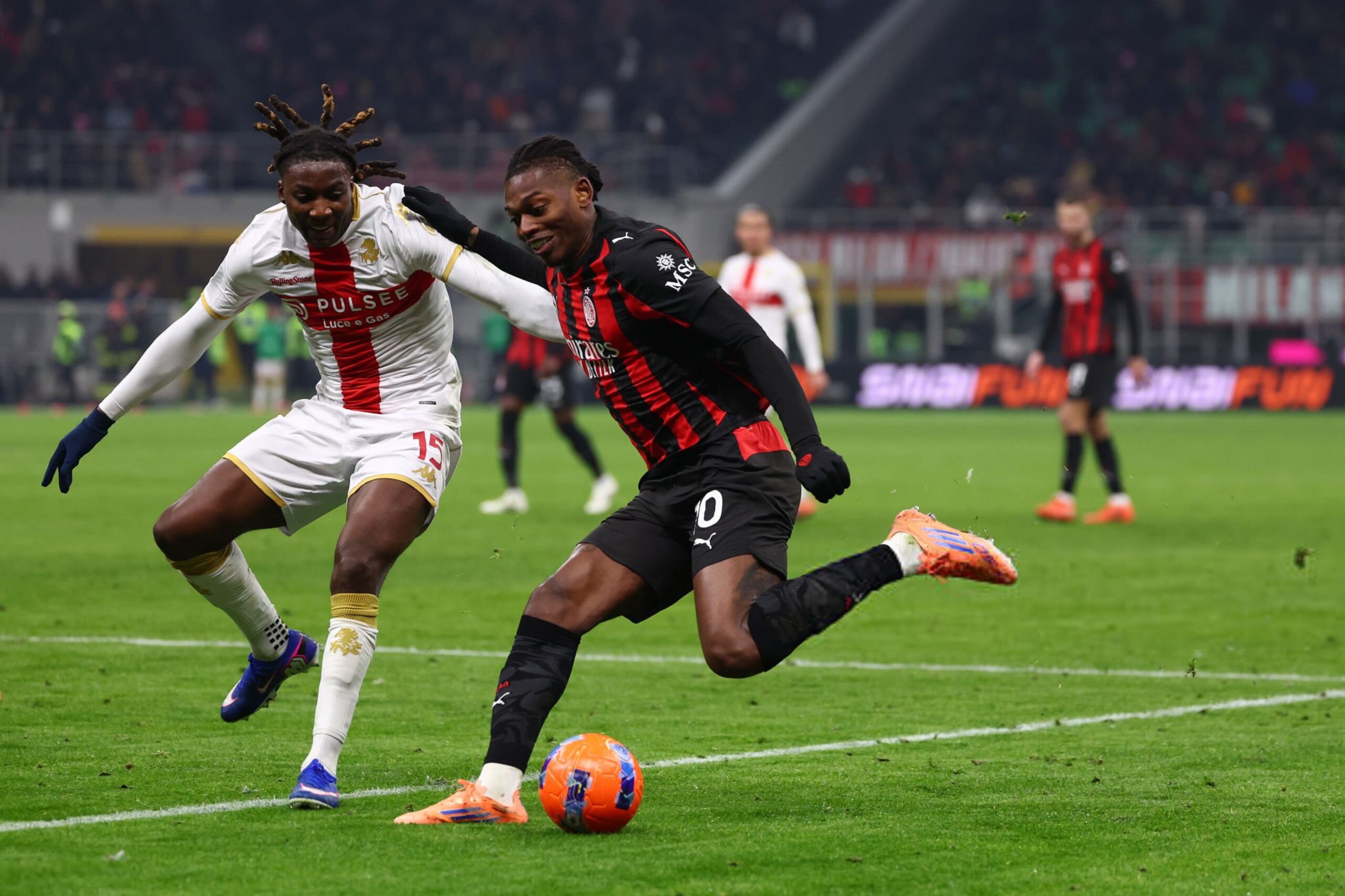
One statistic more than any other tells the story of Rafael Leao’s season: dribbling. For years it was the symbol of his athletic and technical superiority. The Portuguese winger in full stride seemed unstoppable; it always took at least a double-team to contain him, and often even that was not enough. Today, however, the numbers describe a player who looks restrained, less explosive and, above all, less central in his natural habitat.
This season Leao has completed only 24 dribbles out of 56 attempted, with a success rate well below 50%. These figures are miles away from those of the Scudetto-winning season, when he attempted as many as 184 dribbles and completed 98 of them: almost double the current number of attempts, with devastating consistency. Even in the previous season his numbers were clearly superior: 70 attempted, 40 successful. Even more striking was the figure from his debut season, which ended with a success rate close to 62%.
A different role and a less favourable context
Today Rafael Leao no longer receives the ball in ideal conditions to take on defenders. The more central role designed for him by Massimiliano Allegri has moved him away from the wing, depriving him of the space and distance to attack at speed — precisely the environment where he has always performed best.
Also weighing on him are pubalgia, which has limited his sharpness and athletic consistency, and the context of Serie A, a tactical league full of defensive double-teams. In a team less attack-minded than in the past, Leao has therefore found himself more isolated and less able to showcase his one-on-one ability.
The comparison with Kvaratskhelia
The comparison with Khvicha Kvaratskhelia inevitably resurfaces. In 2023 the two were often linked because of their impact and ability to beat defenders, but since then their paths have gone in opposite directions. After his experience at Napoli, Kvaratskhelia developed even further at Paris Saint-Germain, becoming more complete and consistent within a dynamic, attack-oriented system under Luis Enrique.
Rafael Leao, on the other hand, has experienced almost the opposite trajectory: less freedom, less space and less physical continuity within a more tactically conservative environment. His inconsistency remains a genuine limitation, but the system and the conditions around him have inevitably contributed to the decline in his one-on-one effectiveness.
But can Milan really afford to lose one of its symbolic players?
If Rafael Leao stops beating defenders, Milan loses far more than just a dribble. The team loses unpredictability, numerical superiority, and above all that ability to create danger out of nothing even in the most tightly contested matches. And at a time when alternatives are not immediately available, parting ways with Leao is far from guaranteed to be the best solution.