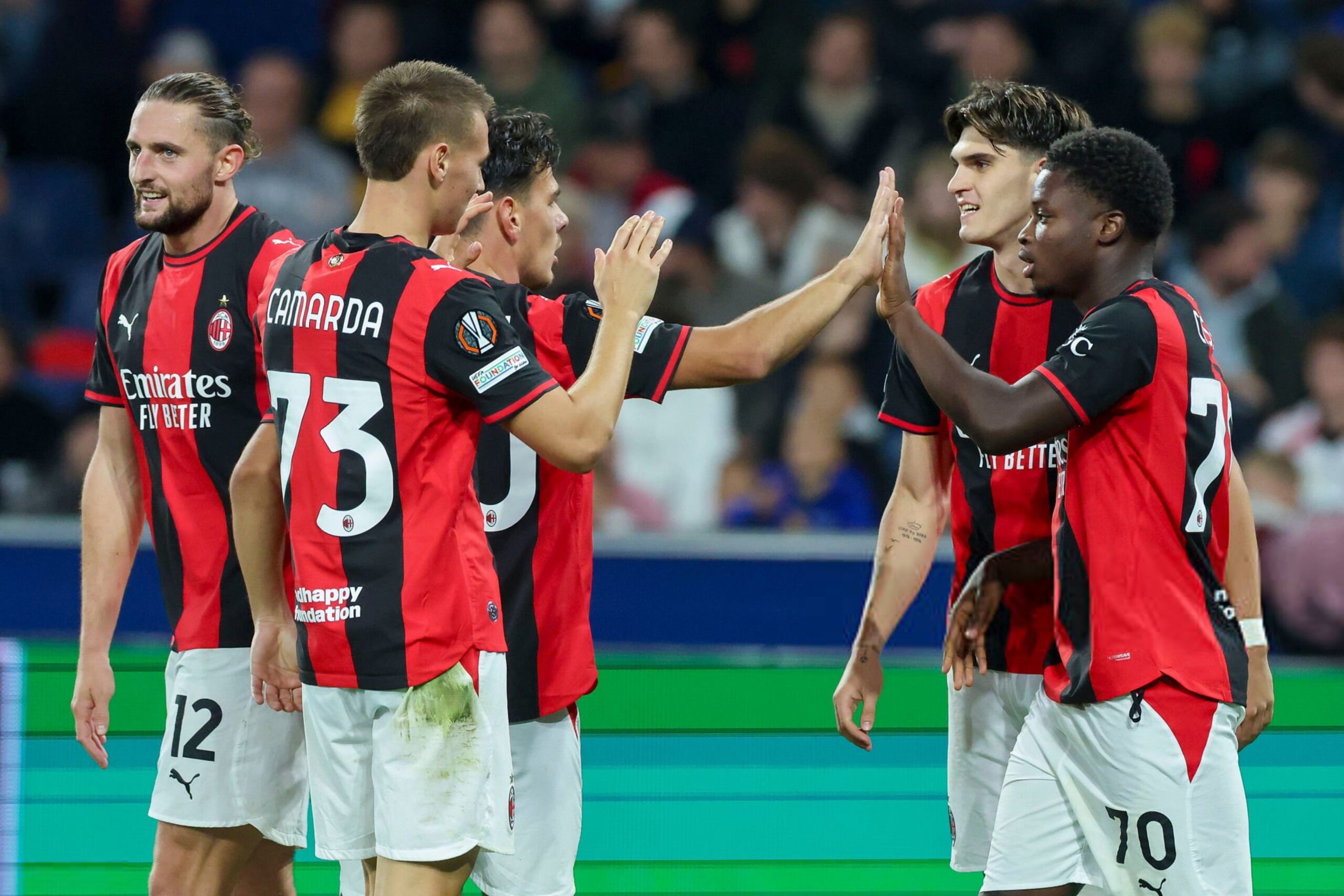

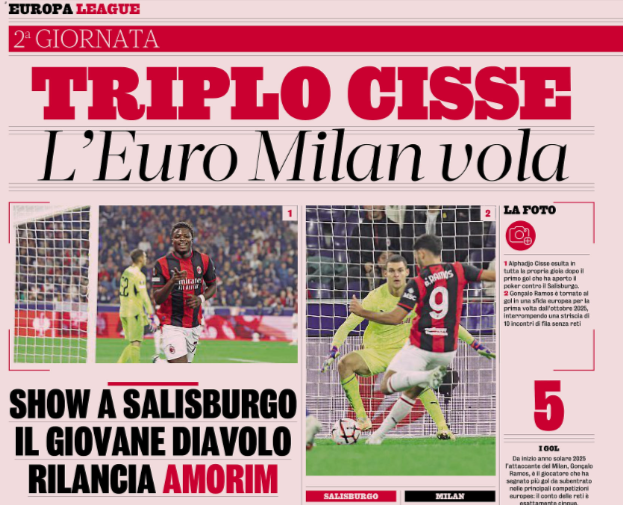
Finally, an 'Alfa' Milan (or rather, an Alphadjo Milan) inspired by the extraordinary Cisse.
The teenage sensation is dazzling Europe too, and is beginning to present Milan with a wonderful selection dilemma, writes Gazzetta dello Sport in this morning's print edition.
After scoring twice in the league, the 19-year-old has now struck three times in European competition. All three were classic centre-forward's goals, spectacular in the way the team created them and in his finishing touch: either getting ahead of his defender or finding space completely unmarked, reminiscent of the great penalty-box strikers of the past.
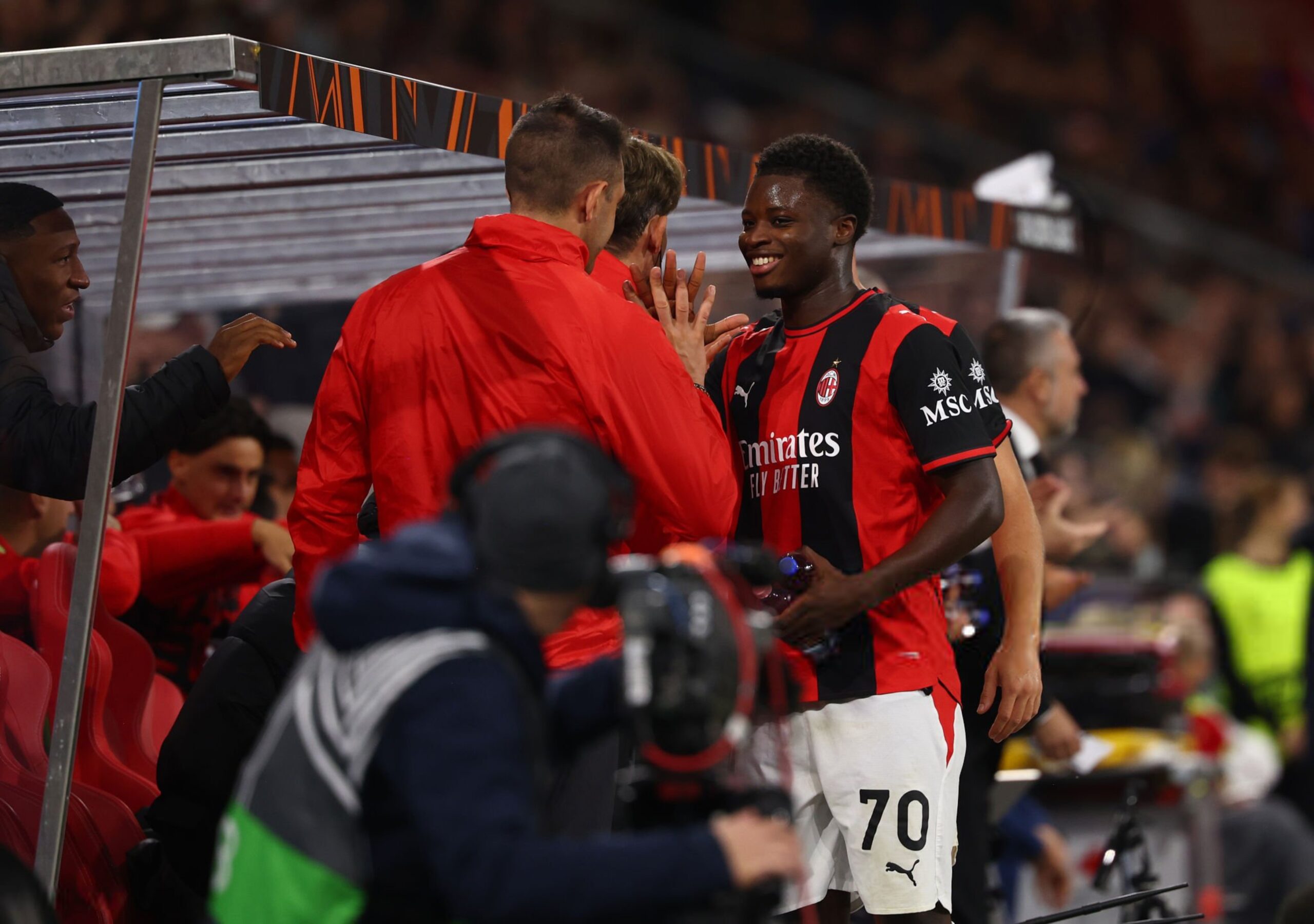
It was an emphatic response to Tresoldi's hat-trick. Admittedly, Cisse's stage was less prestigious, but he is Italian and wants to stay with us, whereas the future of Bruges' number nine remains uncertain.
Of course, a 4–0 victory that sounds so sweet must be treated with considerable caution. It risks creating false expectations. The Salzburg of old (the greatest of Europe's smaller clubs, which reached the Club World Cup two years ago) is no longer there. We simply did not expect them to have fallen quite so far.
Or perhaps it was the Rossoneri who made them look so ordinary. It was almost a training exercise, but that should not diminish either the result or the performance. Quite the opposite. This is exactly how Milan should approach European matches against weaker opponents, just as PSG, Bayern, Arsenal and the other giants routinely do.
There is no better remedy for wiping away the darkness of the Benfica defeat.
No Illusions, But…
For a more balanced assessment, however, it would be wiser to wait until the third matchday trip to Bournemouth (English opponents must never be underestimated) and, before that, Sunday's meeting with Atalanta. Still, this was precisely the breath of fresh air Milan needed. After the Sassuolo match, the atmosphere had become increasingly tense.
It was a welcome boost for Ramos too, who came off the bench to score the fourth goal. And it was equally important for Amorim, who answered some of the doubts surrounding him. His much-publicised attacking, aggressive brand of football had barely been visible during his first two months at Milan.
Here in Salzburg, the Portuguese coach produced a Milan side whose tactical system was almost impossible to decipher, even from the stands, let alone for Salzburg, who never found a countermeasure and simply accepted the Rossoneri's constant movement.
The Austrians contributed to their own downfall, playing with a defensive line far too high for their technical ability, a midfield constantly outnumbered, and an attack in which Tabaković, the Bosnian executioner in the World Cup playoff, barely received a pass and did little to seek one out.
Coach Röhl was hardly beyond criticism either. Excluding the goalkeeper, Salzburg's best player appeared to be Diakité, who came on late and at least managed to shoot at goal.
Rabiot Involved in Three Goals
It is one thing for Spanish football to set the standard, or even Belgium and the Netherlands, with clubs such as Real Madrid, Bruges and Feyenoord. But it would have been quite a paradox if the Austrian league had also become more competitive than Serie A. And yet, considering Salzburg's second place in the Austrian Bundesliga and their 1–0 win over Levski in the opening round of the
Europa League, Milan's achievement deserves proper recognition.
Milan were dominant. Two goals in each half. And Rabiot was involved in all three of Cisse's goals.
The opener began with the Frenchman releasing Hutchinson down the right. His cross found Cisse, who beat the unfortunate Morgalla to the ball with a header.
The second goal developed down the left, once again from a long Rabiot pass, followed by Bartesaghi's first-time assist for the young Italian.
Early in the second half, with a marginal offside decision requiring an extended VAR review, another move involving Rabiot and Loftus-Cheek ended with Cisse completing his hat-trick.
Then came the substitutions and the introductions of Modrić, Pulisic and Ramos. Jashari surged forward and supplied the assist for the Portuguese striker to make it four.
Milan also created several other opportunities, either wasted or denied by the goalkeeper.
Milan: Impossible to Read
Everything looked easy, partly because Milan left Salzburg completely disoriented, denying their opponents any reliable reference points. Cisse's three goals, for example, were all those of a natural centre-forward, even though he was playing on the left of the attack with Camarda through the middle.
The other young Italian may not immediately catch the eye, but his movement, dragging defenders away from their positions, is a vital tactical element. Milan shifted fluidly between a back four and a back three, increasingly favouring the former.
Bartesaghi operated as an attacking full-back, advancing into a midfield where Jashari played as the deepest midfielder, while Rabiot and Loftus-Cheek sliced through Salzburg like razor-sharp blades.
Hutchinson was equally important, performing a role somewhat reminiscent of Politano under Conte: right winger in a 4-3-3, midfielder in a defensive 4-4-2 and, when necessary, a fifth defender at the back. Reproducing these mechanisms against more experienced and tactically sophisticated opponents will not be easy.
But at least Milan have shown that they are alive, that there is real potential in this team, and that they can rise above the anonymity of performances such as the one against Sassuolo.
Now they must do it again. And again. And again.