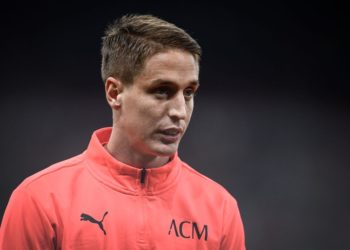


Andrea Conti arrived at Milan during the summer of Fassone's famous “formal things”, but his Rossoneri adventure was unfortunately marked by a long series of physical problems and injuries, which ultimately led to his retirement from professional football at just 31 years of age.
The former full-back, interviewed by FanPage, opened up and spoke about everything: his injuries, his time at Milan, the difficulties of getting his career back on track and his new journey as a coach in the youth ranks of Scanzorosciate, in the province of Bergamo.
Andrea, let's start with the present. You have closed an important chapter of your life and decided to retire. How are you feeling personally today?
“I'm well, to tell you the truth. It's something I've already come to terms with some time ago, because when I made this decision, I was already aware of what I was about to do. The last two years, two and a half years of my career, when I was at Sampdoria, were not good at all for me, both physically and, consequently, mentally. I was already beginning to come to terms with this idea internally. Then, once my contract had ended, I told myself that perhaps, if something came along that genuinely interested me, I could have continued. But even if I hadn't found anything, I wouldn't have minded. So, by the time I reached the final decision, I was already quite far along with this way of thinking.”
So was it mainly a decision made mentally?
“Yes. Because perhaps physically you still think you can offer something, even in a lower division, but if your mind tells you something different, it is right to listen to it. I also decided to retire because, honestly, I didn't feel like continuing in the lower divisions. I could have done it, but it wasn't what I wanted.”
And now you have started again in the youth ranks of Scanzorosciate. How did this new adventure come about?
“The basic idea was to continue in football as a coach. My dream, one day, would be to become a proper coach, perhaps even reach Serie A. But as a starting point, I really like working with young players. I took the course to obtain my coaching licence and be qualified to coach. The Scanzorosciate opportunity also came about because I take my son there. Since I live nearby, I enrolled him with this club, which is very well known in the area. After professional clubs such as Atalanta and AlbinoLeffe, Scanzorosciate is one of the most important clubs in the area. Tino Russo, the head of the youth sector, had already asked me last year whether I wanted to give him a hand. At that moment, however, I wasn't in the right frame of mind yet and didn't feel ready to take on a commitment that I might not have approached seriously. When I make a commitment, I want to do things properly. This year, having obtained my coaching licence, the opportunity came around again and I decided to accept, starting to get myself back on track a little.”
Let's go back to Conti the footballer. You broke through at Atalanta under Gian Piero Gasperini. How gruelling were his preparations?
“My breakthrough was mainly thanks to Gasperini. He knew how to bring out the best in me, but also in many other young players over the years. In my opinion, he is very good at developing young players. He comes from a youth academy background and knows how to deal with young players, what kind of work to do with them and how to bring out the best in them. His working methodology is demanding because he makes you work a lot, both technically and physically. Training sessions are really very tough, especially during the summer training camp and in the first few days of the week. Then, as the match approaches, the intensity decreases because you have to arrive fresh for Sunday.”

In 2017, Milan and Chelsea came calling. Looking back, have you ever reconsidered that crossroads?
“No, absolutely not. Looking back, everything is easier, but it is not something I regret. I was born into a club like Milan, which is one of the most important clubs in Europe and the world. I believe that what happened to me would have happened to me anywhere. It's not as though I wouldn't have got injured if I had gone somewhere else. On the contrary, for me, going to play for a club like Milan was the fulfilment of a childhood dream. Every child dreams of playing for the big clubs, especially the Italian ones. I will be eternally grateful for the opportunity I had.”
Just a few days after your Italy debut, your first serious injury arrived. How decisive was that moment?
“If I could erase just one day from my career, I would certainly erase that training session when I got injured for the first time. I think my decline more or less began there. That day, I had already trained in less than ideal condition because I wasn't feeling very well. If I could erase one day, I would certainly erase that one.”
Have you ever thought that a different medical approach could have changed your career?
“It's something that will always stay with me. It's normal to think: ‘What would have happened if everything had gone well the first time?’ But then you have to make peace with yourself and tell yourself that things have gone the way they have. You cannot turn back time. I couldn't have done any more than I did to try to be in the best possible condition. So, from that point of view, my conscience is clear. Then, naturally, every now and again you think about it and say: ‘Damn, if things had gone differently, perhaps today I wouldn't be at home taking my coaching course. Perhaps I would still be playing.’”
At one point, you were also labelled a 'fragile player'. How much did that label weigh on you?
“To a certain extent. At first, perhaps you give it some importance, but then it takes a back seat and you stop thinking about it. It's also normal for these labels to be given. There are many other players who have suffered numerous injuries during their careers and have been labelled fragile. It's part of the game. The journalist sees a player who keeps getting injured, so naturally he labels him as fragile. How can you blame him? These are things that are part of the profession.”
Then came a season in which you were a regular starter and doing well, but afterwards you found yourself on the fringes under Pioli. How do you experience a situation like that?
“It's not easy. In 2020, during the season after Covid, I was playing regularly. Then I suffered an injury, underwent surgery and was out for a couple of months. From the moment I returned, I never played again and found myself somewhat on the fringes. I don't know whether it was down to the coach's decisions, the club's decisions or something else. But it's not easy to go from a situation where you're playing to one where you practically become invisible. Perhaps many people on the outside think: ‘You're a footballer, you earn a lot of money, you don't play, so nothing changes for you.’ But I can assure you that for 90% of players, the most important thing is playing, feeling well and being happy. At a certain point, money takes a back seat.”
And also because playing is your job...
"Exactly. If you don't work, the money doesn't come in. These are difficult situations to deal with. Perhaps you think: ‘I'll leave and try somewhere else.’ But where do you go? You go from being the fragile player to being the invisible player. And then who is going to take you? From the outside, everything may seem easy, but on the inside, these are complicated situations."
Conti, at Sampdoria, you experienced further physical problems. One of them was Haglund's syndrome. What exactly is it?
“Basically, part of your heel bone, instead of being rounded, is pointed. This point rubs against the tendon and gradually damages it. In my case, there was a tendon injury caused precisely by the fact that the heel bone was pointed and kept hitting the tendon. With the operation, I had to repair the injury and remove this pointed part of the heel bone by filing it down.”
At Milan, you also crossed paths with Ibrahimović. You have spoken about Primavera players who even ended up crying because of his manner. Today, with the young players you described earlier, would leadership like Zlatan's still be sustainable? Conti replied:
“I think it would be difficult for today's young players to handle, but his way of doing things is what took him to the levels he reached and fully reflects the character he is. I am absolutely not against his way of behaving. Quite the opposite. He is someone who pushes you and makes you always give your best. If you are mentally strong, these are things you can handle and which perhaps push you to give something extra. If, on the other hand, you are mentally weaker, you may find them more difficult to tolerate. But Zlatan was a charismatic leader, a technical leader, someone who made his presence felt. The career he had shows that this way of being was part of who he was.”
And how important was he in Milan's transformation towards winning the Scudetto?
“He played an important part. During those two years, he was part of Milan's transformation. If he hadn't been there, I'm not saying Milan wouldn't have won the Scudetto, but he certainly played an important role. And there is something else that must be acknowledged about him: off the pitch, he is a different person. He is pleasant, funny and someone you can joke around with. On the pitch, however, he is demanding. But if you want to be a champion, you cannot always be gentle and give everyone little kisses.”
Today, you are on the other side of the fence. You are the one who has to teach young players. What is the most important advice you feel you can give to a youngster who dreams of becoming a footballer?
“To believe in it wholeheartedly. But believing is not enough: you have to do everything possible to achieve that dream. You have to make sacrifices, work hard and be available. I'm not saying you have to agree to everything, but you have to be 100% focused on what you want to do.”
Conti, how do you avoid burning yourself out?
"By taking the necessary steps for the stage you are at. If a player is ready to play in Serie C, he should play in Serie C without any problems. If he is ready for Serie B, then it is right for him to play in Serie B. You have to take the different steps in the right way."
Do you think, for example, that a very young player should have the courage to drop down a division in order to play regularly?
“Yes. If a young player is at a stage where he needs to play and develop, I think it is better to be at a team where he can play 30-35 matches rather than sit on the sidelines in a higher division. The important thing is to understand where you are in your journey and take the right step at that moment.”