

Last season Milan won eight league games 1-0. Under Massimiliano Allegri the Rossoneri finished fifth on 70 points with a record built on shut-outs, and one number captures how those matches looked: both teams scored in only 18 of the 38. That is the lowest share in any of Milan's last ten Serie A seasons. Four league games into Ruben Amorim's tenure it has already happened three times.
The both-teams-to-score count is a blunt statistic, which is its appeal. It ignores possession, expected goals and who deserved what, and asks one thing of a match: did each side find the net at least once? Counted over a season it is a quick read on how open a team's games are, and counted over ten it shows which parts of that picture belong to the club and which to a particular year.
So is this a different Milan, or four matches of noise? Ten seasons of results give a clearer answer than the last month can.
The Allegri season in numbers
Milan scored 53 and conceded 35 in 2025/26. Only Como, Roma and Juventus let in fewer. There were 15 clean sheets and 13 wins to nil, and 13 of the 38 matches finished with one goal or none at all. The average Milan league game produced 2.32 goals, against 3.29 two years earlier.
The league moved the same way. Both teams scored in 172 of Serie A's 380 matches, 45.26%, the lowest figure of the decade for a competition that reached 62.11% in 2019/20. Measured against that backdrop Milan's 47.37% was actually a touch above average. It was a quiet team in a very quiet league.
Ten seasons at a glance
| Season | Both scored | Milan | Serie A |
| 2016/17 | 22 of 38 | 57.89% | 57.37% |
| 2017/18 | 20 of 38 | 52.63% | 49.47% |
| 2018/19 | 21 of 38 | 55.26% | 53.42% |
| 2019/20 | 22 of 38 | 57.89% | 62.11% |
| 2020/21 | 19 of 38 | 50.00% | 59.74% |
| 2021/22 | 19 of 38 | 50.00% | 57.37% |
| 2022/23 | 23 of 38 | 60.53% | 50.26% |
| 2023/24 | 23 of 38 | 60.53% | 52.37% |
| 2024/25 | 22 of 38 | 57.89% | 51.58% |
| 2025/26 | 18 of 38 | 47.37% | 45.26% |
Across the ten seasons both teams scored in 209 of Milan's 380 league matches, exactly 55%. Serie A as a whole sits at 53.89% over the same period. On the long view Milan are an ordinary side by this measure. The interesting part is how far individual seasons sit from that line, and in which direction.
Two Milans under one coach
The clearest lesson is inside the Stefano Pioli years. In 2020/21 and 2021/22 both teams scored in 19 of 38, while the league around Milan was running at 57 to 60%. The Scudetto side of 2021/22 kept 18 clean sheets and conceded 31 goals. Opponents simply did not score often enough for matches to open up.
Then the same coach, with much of the same squad, produced the opposite profile. In 2022/23 and 2023/24 the count rose to 23 of 38 in a league that had gone quiet, putting Milan eight to ten points above the Serie A average. The 2023/24 team scored 76 and conceded 49.
The season that followed, split between Paulo Fonseca and Sérgio Conceição, stayed in the same register: 22 of 38, with 61 scored and 43 conceded.
Milan scored in 32 to 35 of their 38 games in every one of those five seasons. What changed was the other end: opponents scored in 20 matches in the title year and in 25 or 26 afterwards. For a club that almost always finds a goal, this statistic is a defensive one. It tracks clean sheets far more closely than it tracks the attack, the badge or the name on the bench.
The San Siro gap
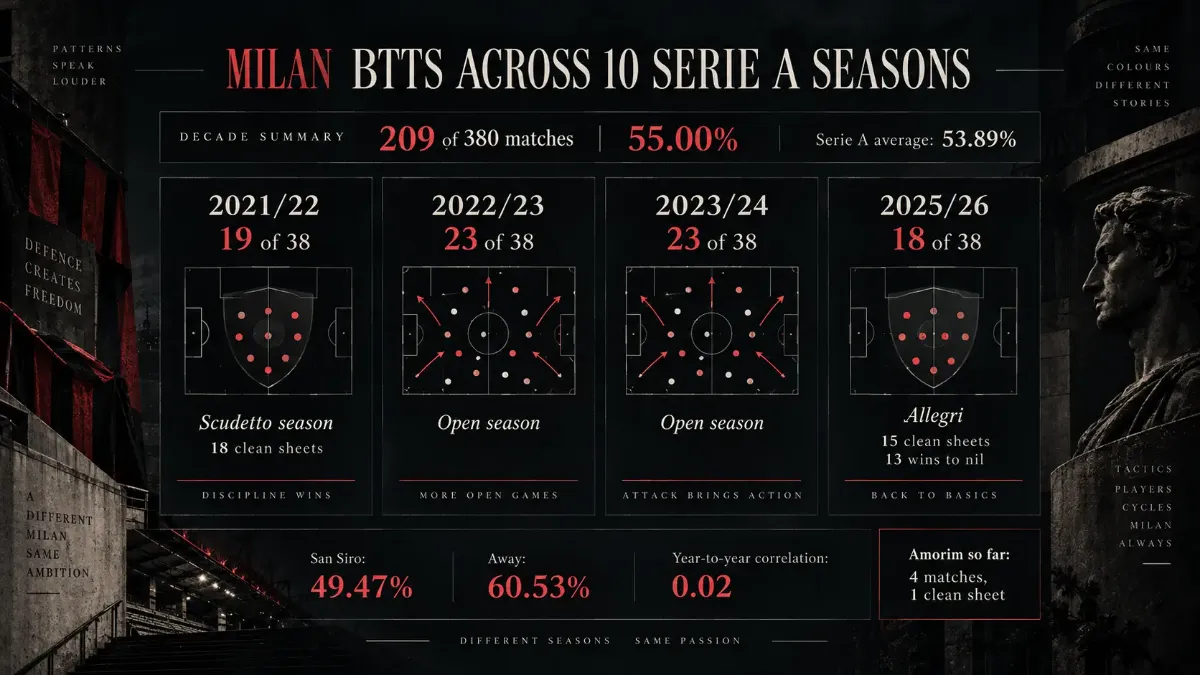
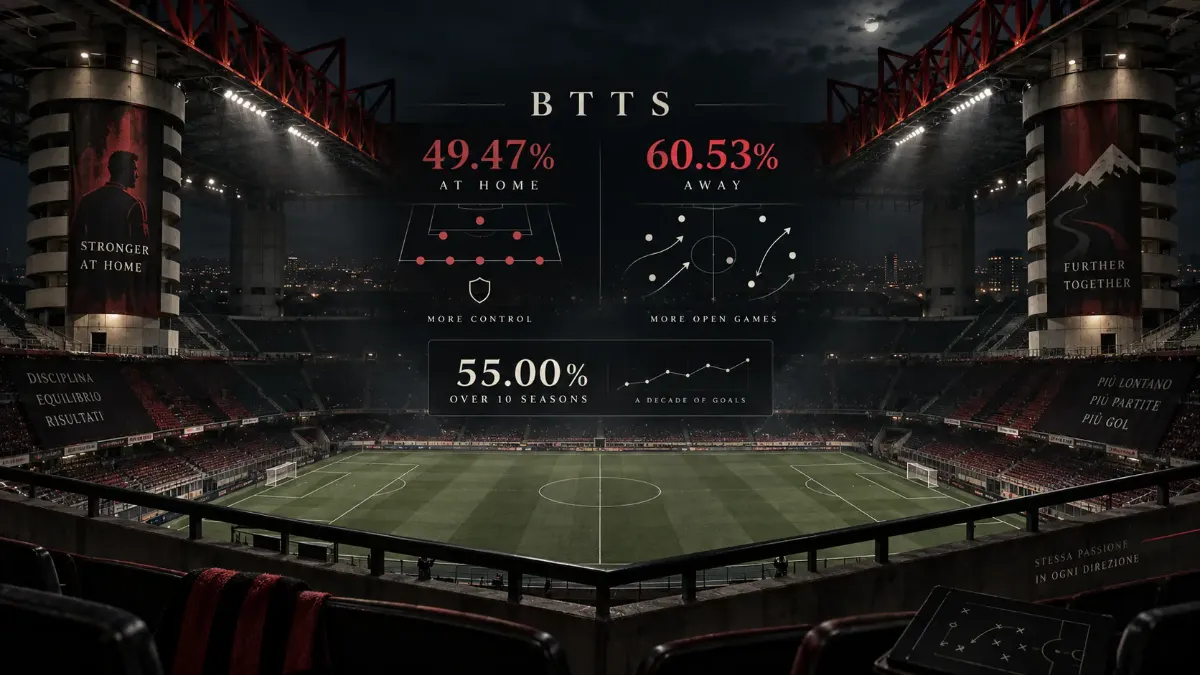
Split the decade by venue and something else appears. At San Siro both teams scored in 94 of 190 league matches, 49.47%. Away from home it was 115 of 190, or 60.53%.
The attack is not the reason. Milan scored in 81.6% of home games and 85.8% of away games, and averaged 1.64 goals at home against 1.66 on the road. The difference is again at the back: visiting sides scored in 59.5% of their trips to San Siro, while hosts scored against Milan in 70.5% of away fixtures. Of the other big Italian clubs only Juventus show a split of similar size over the same ten years, and a gap this wide would appear by luck alone about three times in a hundred, so it deserves caution rather than a theory.
Last season broke the pattern. Both teams scored in 10 of 19 at home and only 8 of 19 away, just the second season of the ten in which San Siro saw more of it than the road, and the widest margin. Away from home opponents scored in only 11 of Milan's 19 matches, well below the ten-year norm, while at San Siro they scored in 12 of 19. That fits the picture in our piece on Milan's recent home record: under Allegri the away record tightened, and it was at home that goals kept going in at the wrong end.
Why one season tells you so little
Here is the number that should cool any early conclusion. Compare each Milan season with the one that followed and the correlation is 0.02, which is as close to nothing as statistics gets. A season with plenty of goals at both ends has been no guide at all to the next one.
Part of that is simply the size of a season. Eighteen from 38 is 47%, but a record of that length is consistent with a true long-run rate anywhere between roughly 33% and 63%. The same holds well beyond Milan. BTTS.football, which publishes this statistic for eleven leagues with the match count printed beside every percentage, compared 1,213 club-seasons with the season that followed each of them and found that one year explains about 4% of the next. Squads change, coaches change, and 38 matches were never many to begin with.
What to watch under Amorim
Before the Lecce game Milan had played four league matches under Amorim. They scored in all four and conceded in three, with the home win over Venezia the only clean sheet. Four games cannot separate a change of style from a run of fixtures, and nobody should pretend otherwise.
What the decade does say is where to look. Milan's attack has been a constant: goals in at least 28 of 38 league games every season, and in 31 or more in eight of the ten. The figure that has swung between eras is how often the opponent scores, from 20 matches in the title season to 26 in the open years. If Amorim's side keeps clean sheets at anything like last season's rate of 15, the matches will stay tight whatever the system looks like. If that number falls back towards 12, expect the scorelines of 2023/24 to return, along with the questions that came with them.
All figures are Serie A matches only, settled on 90 minutes, from 2016/2017 to 2025/2026. Current season counts are as of 20 September 2026, before Milan v Lecce.