
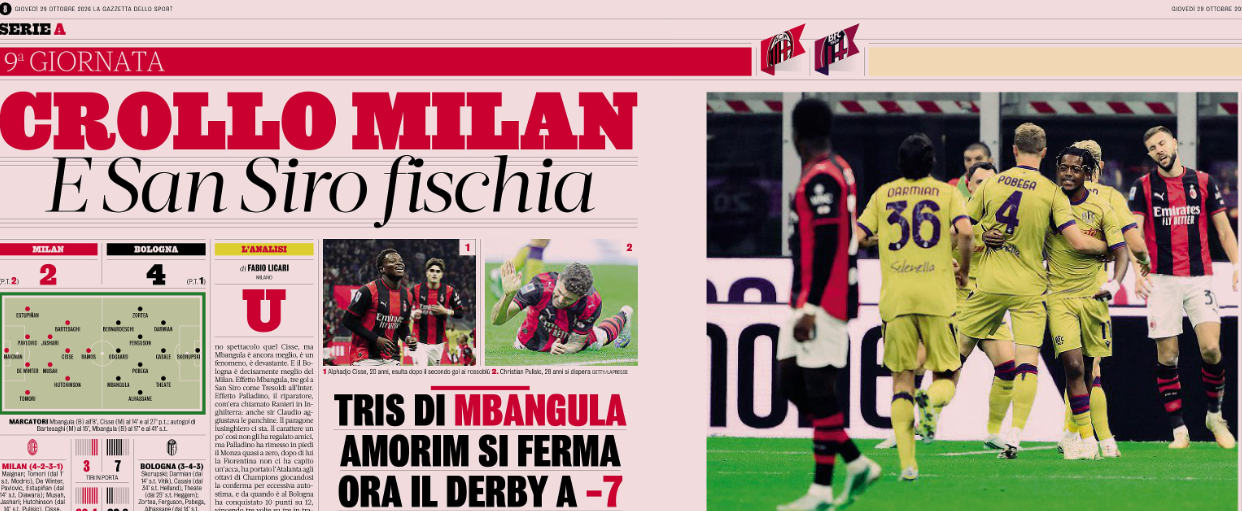
What a spectacle Cisse is, but Mbangula is even better, he is a phenomenon, he is devastating. And Bologna are decidedly better than Milan. The Mbangula effect, three goals at San Siro like Tresoldi against Inter. The Palladino effect, the repairman, as Ranieri was called in England: Sir Claudio also fixed teams by taking over their benches.
The flattering comparison is fitting. His somewhat difficult character has not earned him friends, but Palladino got Monza back on their feet from almost nothing, after him Fiorentina could not make sense of anything, he took Atalanta to the Champions League round of 16, jeopardising his confirmation through excessive self-confidence, and since arriving at Bologna he has collected 10 points out of 12, winning all three of his away matches. Bologna gave Milan and Amorim a lesson in football, tactics, management, decisions, in everything, in short. Trailing 2-1, Palladino turns the match around with three substitutions, winning emphatically 4-2.
The phenomenon is Mbangula, who, however, is always put in a position to beat Maignan thanks to the team's play. The Rossoneri are left with Cisse, whom it is now difficult to consider a substitute: but beneath his clothes, there is nothing. Having seen the indomitable Inter in Venice, the derby is not getting off to the best of starts.
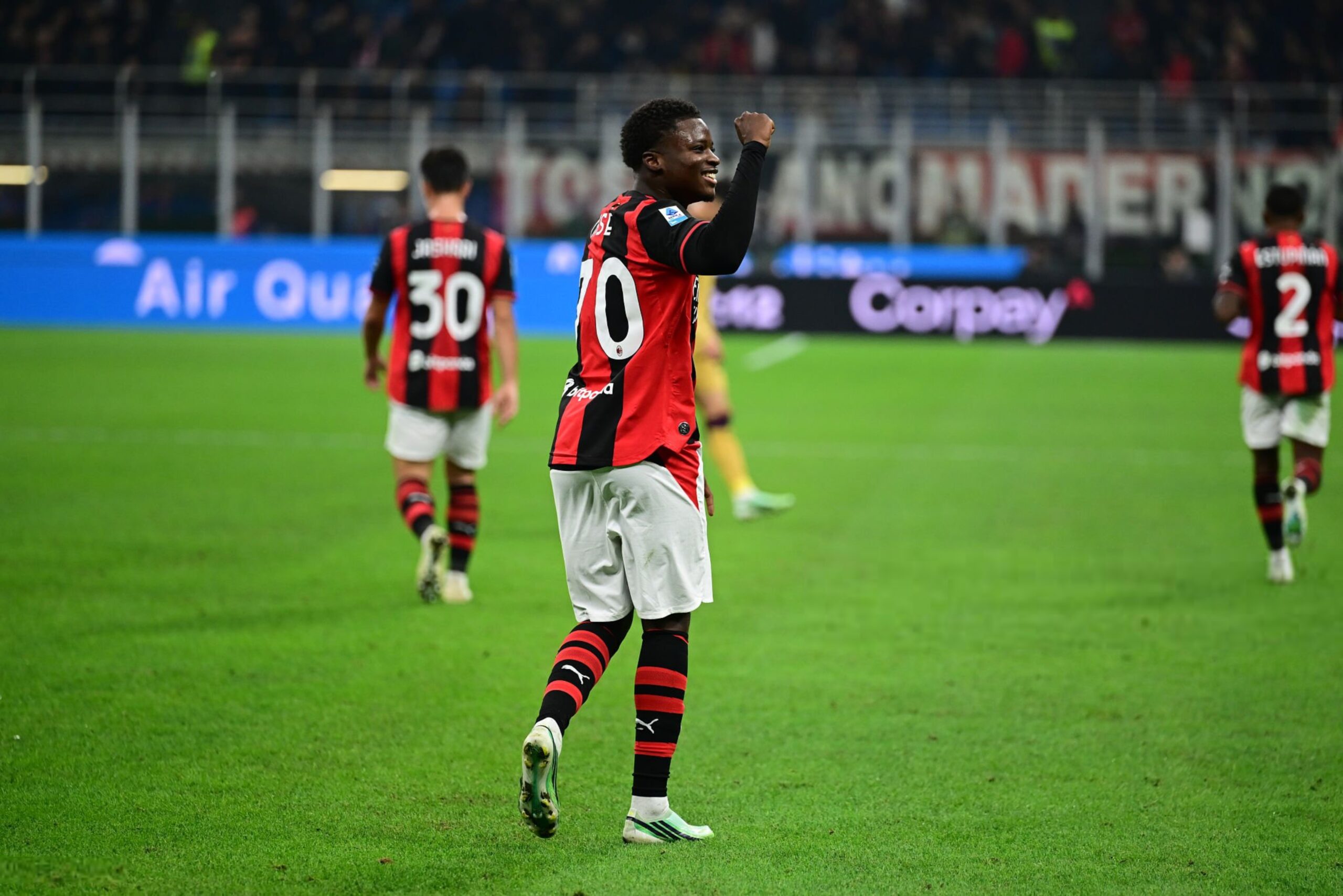
AC Milan and super Cisse
Just as things had not started particularly well against Bologna. In less than ten minutes, the Rossoblù take control of the flanks, have a huge chance with Bernardeschi on the goal line and, following a ball lost by Musah in the attacking third, tear through the Rossoneri from right to left: Pobega, Zortea, Mbangula, goal. Powerful warnings, but ignored, of what was to come. Milan pick themselves up thanks to an unforgivable mistake by Theate, who badly handles possession deep in his own half under pressure from Hutchinson: the ball reaches Cisse in the penalty area, alone and in an ideal position, a quality that Mancini's future Italy international certainly does not lack. Before the half-hour mark, Cisse again: credit goes to the recovered Tomori who, on the right, arrives like Kimi Antonelli, getting ahead of everyone and threading the ball into the middle for the relentless Cisse, 2-1.
Battle between tacticians
Many Rossoneri thoughts follow one another. A team stronger than its seven significant absentees. Amorim continuing his interesting tactical experiments, yesterday a 4-2-3-1, or something close to it, in which a defensive midfielder (Jashari) drops back during build-up play, Tomori at right-back is in his natural role, and on the left Bartesaghi, playing high up, leaves something exposed behind but knows how to push forward. Up front, forgive the blasphemy, Cisse always free in the inside-left channel, with Ramos surrounded in the middle of the penalty area, vaguely recalls the Benzema-CR7 mechanisms: one receives the ball and the other arrives and scores. Vaguely. But Bologna are anything but naive, writes La Gazzetta dello Sport. Theate complicated the plans of a 3-4-3 tending towards a 3-5-2, with man-marking in many areas in Gasperini fashion (Darmian on Cisse, Bernardeschi against Estupiñan) but unpredictable in attack: Odgaard as a false nine to manage the movements, Berna swapping positions with Zortea to move into a playmaking role, and Mbangula making lethal diagonal runs.
Bologna's comeback
Bologna's maturity emerges in the second half, also because Milan no longer have Tomori, one piece of bad luck after another, and Amorim's vision ultimately proves unsuccessful: Modric in the middle and Musah at full-back. The Croatian goes no further than elegant control and passing, but without direction. Palladino goes all in at the 14th minute of the second half: Miranda and Cambiaghi come on down the right side, plus Vitik at the back. It is not mathematics, but a minute later Miranda takes an extremely dangerous free kick across the goal line and Bartesaghi clumsily puts the ball past Maignan. Two minutes later, along the Miranda-Cambiaghi axis, the ball reaches the relentless Mbangula and it is 3-2. Miranda is devastating. Bologna, having been overturned, overturn Milan, but the same trick does not work for Amorim, who creates more confusion than anything else: his substitutions, made at the same time as Palladino's, are Pulisic and Diawara, but after the two goals the coach also brings on Camarda. Milan thus become a 4-2-4 with an attack consisting of Cisse, Ramos, Pulisic and Camarda. Four forwards do not always score goals, but they can create imbalances, especially if the midfield does not provide protection. Camarda is doubly at fault: first he wastes the chance to make it 3-3 with a header, then he loses the ball, triggering Odgaard's counterattack, with the latter providing Mbangula from the right: 2-4. Adios.
Looking ahead...
Milan are all at sea from the moment it becomes 2-2, Bologna are in complete control. Milan remain fifth, but seven points behind Inter and Lazio, while Bologna climb out of the lower reaches of the table and, under Palladino, have collected the same number of points as Como over five matchdays and one more than Roma: next up are Monza, Parma, Udinese and Venezia in succession, not exactly top opposition, so they could climb the standings. Amorim's constant movement and tactical changes are creating something, but the emergency situation (Rabiot, Gila, Moreira and Tomori all out) calls for a little more stability, without questioning Cisse's place in the starting lineup, whatever his age.