
Milan are facing a choice that carries far more weight than simply deciding the name on the bench. After all the difficulties of the season just concluded, and with a club structure that is still taking shape, the new manager will have to be much more than a caretaker. He will need to provide identity, stability, credibility, and a clear technical direction to a team that could currently be described as lost. Three names are currently in the running to fill the vacancy left by Massimiliano Allegri: Mauricio Pochettino, the current head coach of the United States national team; Oliver Glasner, regarded by many as one of the leading favourites for the Rossoneri bench; and Matthias Jaissle, a young gamble currently at Al-Ahli.
On Mauricio Pochettino - Big name, but not without doubts
Of the three candidates, Mauricio Pochettino is the most prestigious internationally, particularly because we are talking about a Champions League finalist with Tottenham, as well as a coach with considerably more experience than the others, having been on the managerial scene since 2009. Throughout his career he has worked in different leagues, under varying levels of pressure, and in diverse environments: Espanyol, Southampton, Tottenham, PSG, Chelsea, and now the United States national team.
The Argentine coach's numbers tell the story of a career marked by highly contrasting phases. At Espanyol he averaged 1.22 points per match, at Southampton 1.45, but it was at Tottenham that he made his major breakthrough, building what could be described as a masterpiece of his own making, more in terms of achievement than trophies: 293 matches, 160 wins, and an average of 1.84 points per game. At PSG he raised that average to 2.15, although in a context where winning in France was almost expected. At Chelsea, however, he finished with a modest return of 1.78 points per match, failing to leave a lasting mark before accepting the challenge of leading the United States national team.
His greatest strength, namely his ability to work with talented squads and young players, has often proved to be his biggest limitation. Pochettino has frequently given the impression of being excellent at building competitiveness without ever fully translating it into trophies and tangible success. It is no coincidence that he has only won honours in France, where even then he failed to establish a lasting winning cycle.
Oliver Glasner - The pragmatic winner who builds without making noise
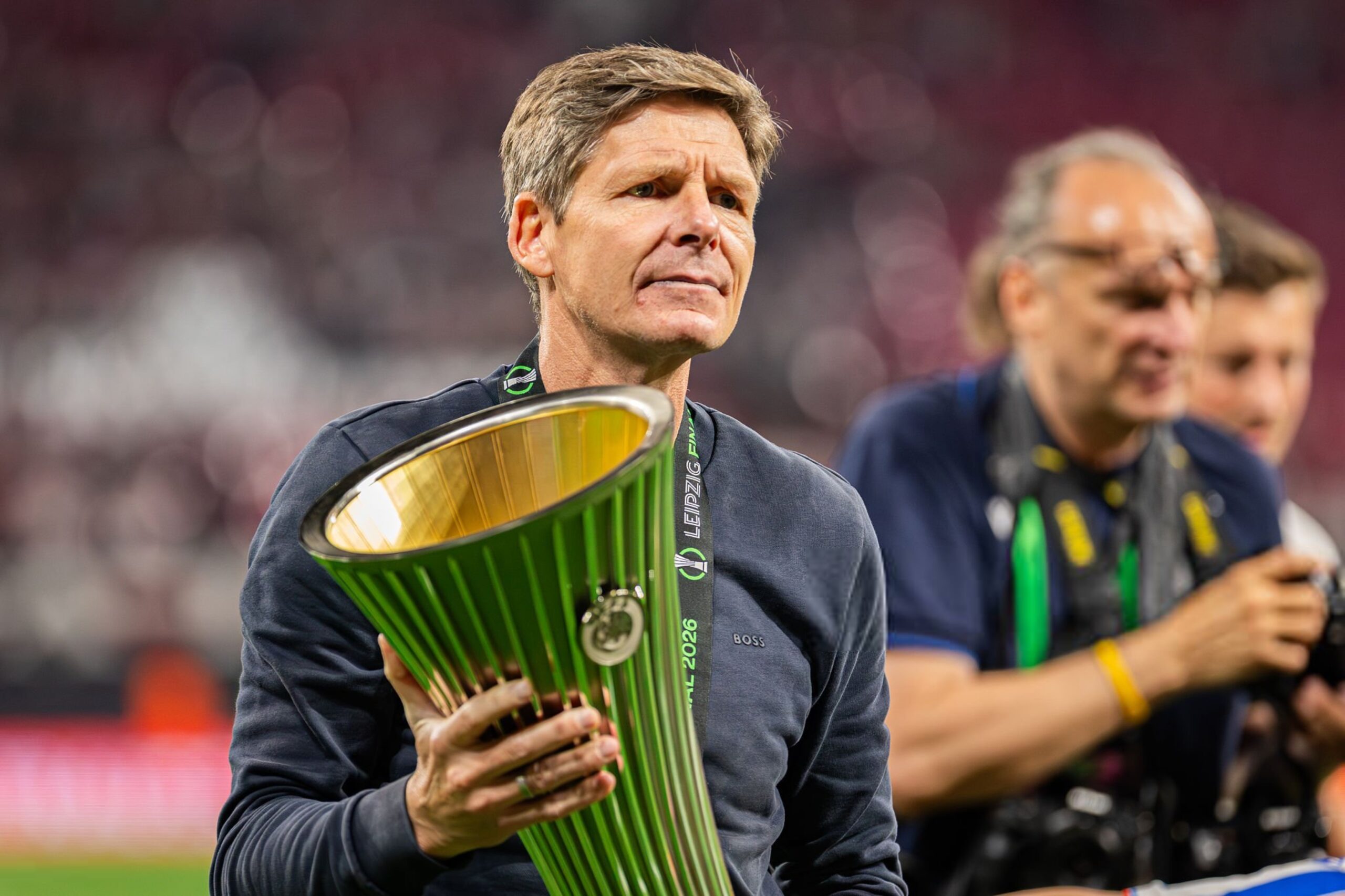
Of the three profiles under consideration, Oliver Glasner is perhaps the most balanced option. He does not possess Pochettino's glamour, but he may have exactly what today's Milan need: substance. He has been coaching since 2012 and has built his career patiently and methodically, progressing step by step without shortcuts, moving through FC Liefering, SV Ried, LASK, Wolfsburg, Eintracht Frankfurt, and Crystal Palace.
The German-speaking coach's career reflects someone capable of making an impact in environments that are not always dominant. At LASK, for example, he produced outstanding numbers: 96 wins in 161 matches, an average of 1.97 points per game, and promotion through the Erste Liga. At Wolfsburg he confirmed his consistency with an average of 1.67 points per match. That figure dropped to 1.51 at Frankfurt, but it should be noted that he won the Europa League there. This is the key point about Glasner: he does not always produce spectacular numbers, but he tends to maximise what he achieves. At Crystal Palace, both the step up and his performances were even more impressive, especially as the Austrian delivered three trophies to a club not accustomed to winning, writes Milannews.it.
So how could Glasner be described?
A coach built around structure, transitions, intensity, and discipline, well suited to a team that needs rebuilding without Champions League football but is still expected to perform strongly in Europe.
Matthias Jaissle: the young gamble
The last of the three leading names for the Milan bench is Matthias Jaissle, the youngest, most modern, riskiest, yet also one of the most intriguing profiles. He has only been coaching since 2021, but his numbers are impressive. At Liefering he averaged 2.12 points per match during his six months in charge, improving further at Salzburg with 2.28 points per game. At Al-Ahli he has maintained those exceptionally high standards, averaging 2.15 points per match.
He has already won two Austrian league titles, an Austrian Cup, a Saudi Super Cup, and two AFC Champions League Elite titles. These are remarkable achievements for such a young coach, although they must be analysed with a degree of perspective. The statistics can be dazzling, but it should be remembered that Jaissle has managed in environments stronger than their domestic competition, often dominating with squads superior to their rivals. Milan, at present, are not in that position. On the contrary, the Rossoneri need to rebuild.
His appeal lies in the Red Bull footballing philosophy, which in many ways aligns with Glasner's: intensity, verticality, pressing, youth development, and aggressive football. If Milan were to embark on a long-term project aimed at the future, Jaissle would make a great deal of sense, even if it would still represent a bold and interesting appointment, particularly if placed within a clear organisational structure, perhaps alongside Rangnick. Without such a framework, however, the German risks becoming an exposed gamble that Milan, in their current situation, simply cannot afford.