
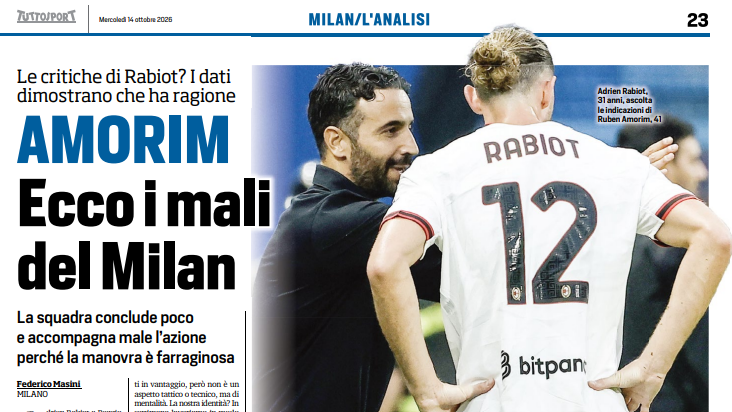
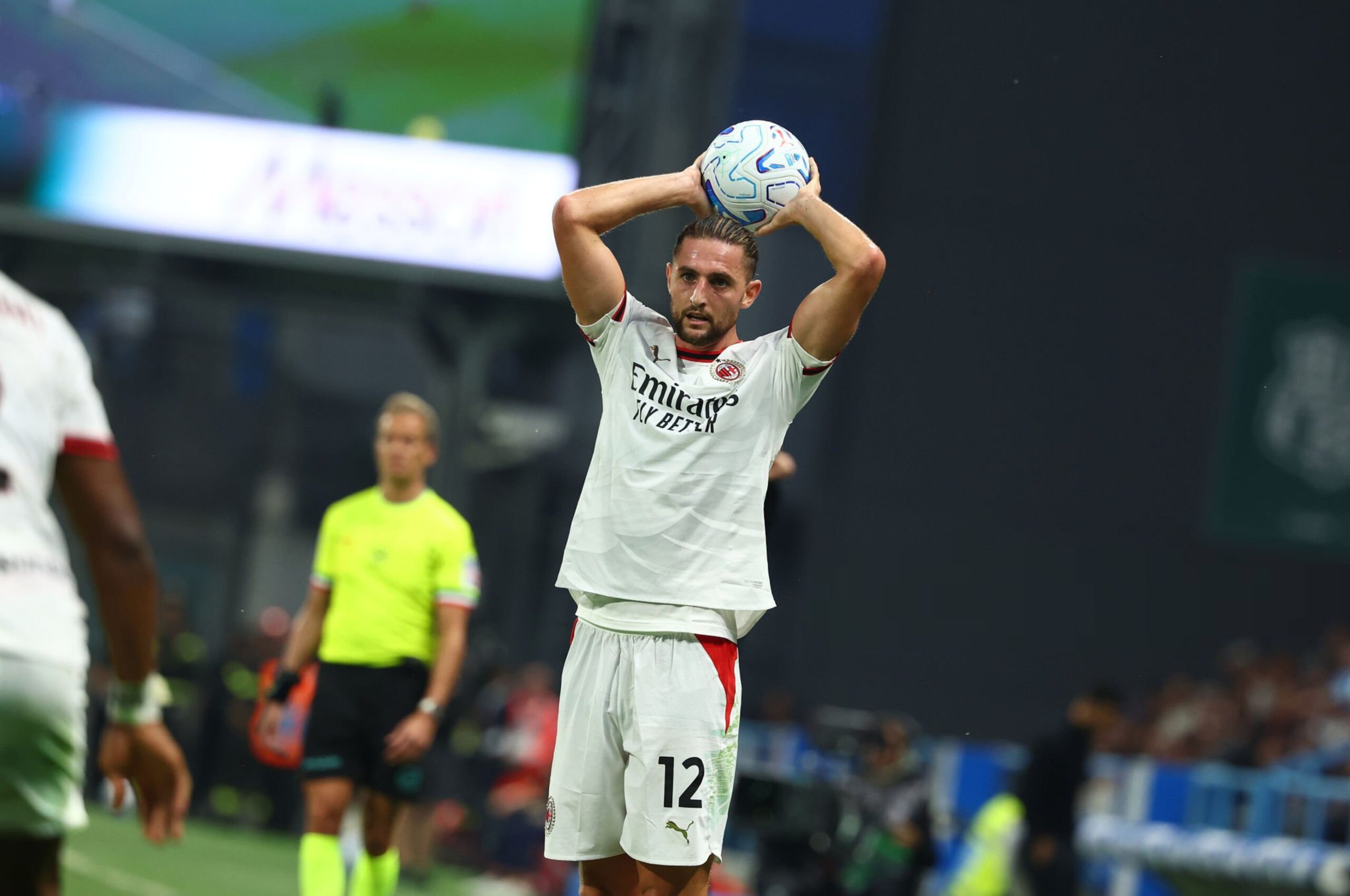
Adrien Rabiot’s comments in Reggio Emilia did not exactly come as a bombshell, nor did they expose some great hidden truth.
The Frenchman, however, offered a clear-headed assessment of Milan’s situation. It was constructive criticism, an honest analysis.
Because although Milan are still unbeaten in the league and sit fifth with 12 points, four behind Inter and Lazio, the team still looks very much like a work in progress. And it is a project surrounded by several question marks, not least because it is difficult to understand exactly what Ruben Amorim is ultimately trying to achieve.
Indeed, we have seen too many different approaches, too many paths explored and then abandoned, sometimes revisited, modified and subsequently discarded once again. Tomorrow in Salzburg, having lost their Europa League opener to Benfica, Milan cannot afford another hesitant performance.
Rabiot, as mentioned, was straightforward:
“We do some good things, but every now and then we fail to do what we should,” he explained. “We cannot concede goals like that, for example, after taking the lead. But it is not a tactical or technical issue; it is a question of mentality.
“Our identity? During the week, we prepare differently depending on the team we are going to face. Being able to defend with a back four or a back three, or build up play with three or four players, can also be a strength.”
In short: inconsistency, concentration, mentality, and perhaps a touch of confusion. Rabiot’s words say it all.
They also highlight another issue that has been obvious to everyone during these opening weeks of the season, even to the least experienced observers:
“We need to get more players into the box when we attack. That is how you score goals.”
Milan have scored 11 goals in six matches, averaging just under two per game. However, they do not register enough shots on target, and even fewer players get forward to support attacking moves, which often look laboured and lack penetration, as relayed via Tuttosport in this morning's print edition.
The player suffering most from this is Gonçalo Ramos, who has managed just one goal in seven appearances.
Amorim has stressed that he wants to improve the team's overall attacking play and that he needs to work on creating chances for every player, not just the Portuguese striker. However, achieving that objective must inevitably involve getting Ramos more involved in finishing attacking moves.
When Rabiot talks about the lack of players in the penalty area, he is stating an undeniable truth.
Across six Serie A matches, Milan’s players have recorded 154 touches in the opposition penalty area. Inter, Milan’s main rivals, have registered no fewer than 255.
And when Cristian Chivu’s side lost to Real Madrid at the Bernabéu, Lautaro Martínez and his teammates recorded 57 touches in the Spanish side’s penalty area, compared with just 38 for Mbappé and his teammates.
Inter play with the primary objective of creating scoring opportunities for their forwards. Naturally, goals also come from players in other positions, but the main purpose of the Nerazzurri’s attacking play is to get “El Toro” Lautaro, Thuram or Pio Esposito on the scoresheet.
At Milan, at least for now, that is not the case.
Of course, there are numerous unresolved issues within a squad that has been assembled poorly and, at times, in a rather frantic manner.
Having failed to find the right person to lead the sporting department, Gerry Cardinale personally selected the coach and spent heavily on three reinforcements (Ramos, Gila and Moreira) without addressing all the weaknesses in the squad.
These decisions were made following recommendations from Amorim, an agent such as Jorge Mendes, and the club’s new executives, many of whom previously worked as scouts or analysts.
Another of Milan’s dilemmas concerns Modrić.
With the Croatian midfielder on the pitch, Milan have a recognisable footballing identity. However, whether they line up in a 3-4-2-1 or a 4-2-3-1 formation, they struggle against opposition counterattacks and suffer whenever they cannot control possession.
Without the former Real Madrid midfielder, as was evident in the first half against Sassuolo, Milan’s attacking play becomes almost nonexistent.
Gabbia’s injury, combined with the change in formation, is also likely to create further problems in defence, where the squad lacks quality alternatives and a natural right-back.
Gila is being played out of position, while Athekame has been sold.
Will Tomori be brought back into the fold?
And when the January transfer window opens, will Milan look to sign a centre-back, with Sporting's Inácio their first choice and Brest's Le Guen another player they admire, or will they prioritise a full-back?