
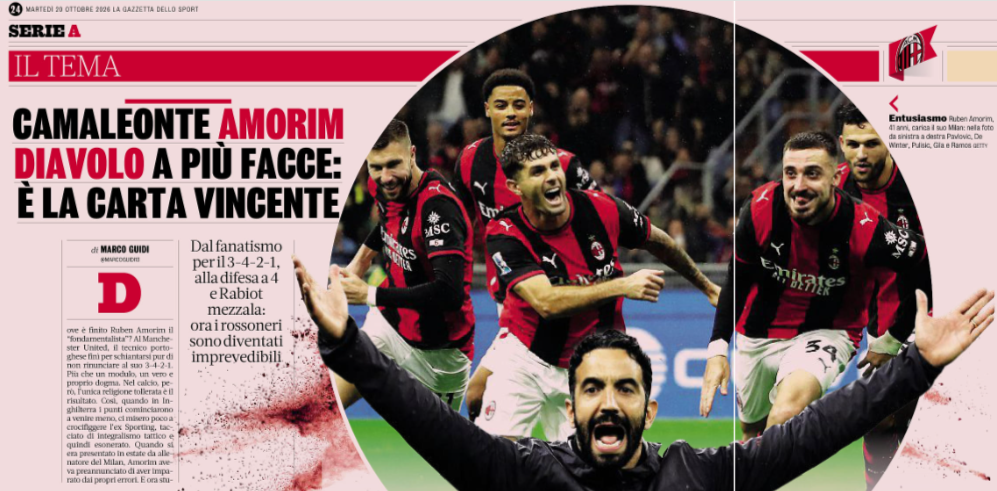
Where has Ruben Amorim the “fundamentalist” gone? At Manchester United, the Portuguese coach ended up crashing rather than giving up his 3-4-2-1. More than a formation, it was a real dogma. In football, however, the only religion tolerated is results. So, when points began to dry up in England, it did not take long for the former Sporting coach to be crucified, accused of tactical fundamentalism and consequently sacked.

When he was introduced as Milan's coach in the summer, Amorim had announced that he had learned from his mistakes. And now it is only surprising up to a certain point that he has become much more flexible, both on and off the pitch. The 3-4-2-1 has disguised itself as a 4-4-2, a 4-2-3-1 and, most recently, a 4-3-3. Because, as Ruben himself recently explained in a press conference, “what matters are the principles of play, not the formations.”
Amorim & the change...
And yet Amorim had started in his own way. From pre-season to the opening matchdays, the 3-4-2-1 had dominated. The turning point came after the Rossoneri's only defeat of the season, against Benfica in the Europa League, when Milan's build-up play had appeared too cumbersome, writes La Gazzetta dello Sport in this morning's print edition.
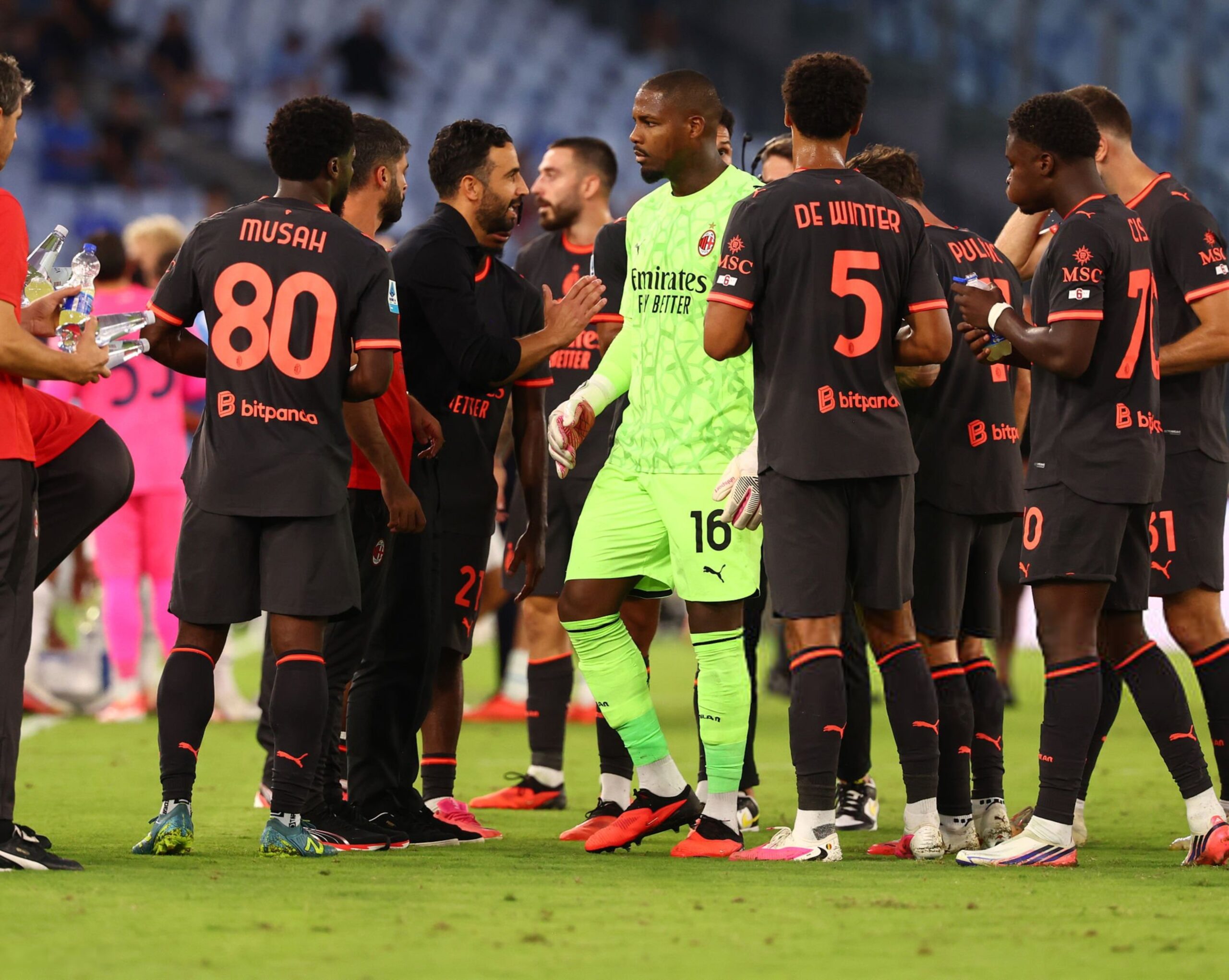
The inspiration for the change came from a discussion with the senior figures in the dressing room, from Modric to Rabiot. The following weekend, at San Siro against Lecce, came the first transformation. The Portuguese coach moved Gila wider to full-back, shifted Pavlovic inside as the second centre-back and dropped Estupinan back into a four-man defensive line.
Chukwueze, who was struggling to cover the entire right flank, moved into a pure winger role, with Saelemaekers on the opposite side. Operating around Gonçalo Ramos, who was starting for the first time, was the revitalised Pulisic.
Whether one wanted to interpret it as a 4-4-2 or a 4-2-3-1, it certainly represented a decisive change of direction compared to the beginning. The convincing 3-0 victory over Lecce then sent Milan into the break with the conviction that Amorim had found a new balance.
“The back four allowed us to play the ball out better,” commented the coach himself after the victory. With a prophetic clarification: “The formation depends on the needs of the moment and the type of match.”
In short, the fundamentalist had almost become a "non-ideologist."
Chameleon...
In any case, the Rossoneri restarted in the same way three weeks later away to Sassuolo. During the 90 minutes of ups and downs at the Mapei Stadium, however, Amorim responded to the difficulties by returning to the 3-4-2-1 in the second half.
An about-face that, combined with the disappointing 1-1 draw, had left the impression of renewed confusion. And here the former Sporting coach had another successful intuition, experimenting with it in the Europa League against Salzburg.
It all stemmed from the need to strengthen the midfield, protect the playmaker (Jashari in Austria, Modric in the "first-choice" version), who would otherwise be forced to cover too much ground in a two-man midfield, and increase the team's level of creativity.
Bingo
Amorim therefore switched to a 4-3-3 that, during a match, can easily become a 4-2-3-1 or even the same 3-4-2-1.
A shape-shifting Milan, designed to give opponents no fixed reference points, perfectly represented by one player in particular: Adrien Rabiot.
The Frenchman, in this handful of matches so far this season, has been three in one: an attacking midfielder making runs forward behind the striker in the 3-4-2-1; a disciplined, controlling midfielder in a two-man midfield in the 4-4-2 or 4-2-3-1; and a central midfielder with the freedom to attack in the 4-3-3.
Milan have thus returned to winning two matches in a row (after the 4-0 victory in Salzburg came the 3-2 success against Atalanta, with Amorim describing the first hour of play against the Nerazzurri as his team's best of the season), and now the fans are confident that the coach has truly found the right balance.
What does the future hold for Amorim and Milan?
Amorim's flexibility in his first nine matches as Rossoneri coach, including the Europa League, suggests that it would be unwise to venture too far into predictions.
Because the strength of the 'Diavolo' seems to lie precisely in the ability to disguise itself according to the circumstances. A quality that the Portuguese coach himself discovered in Milan, after years as a “fanatic” of a single system.
And so perhaps the answer to the question is to turn the question itself upside down: Ruben does not need to find the right balance, because his Milan must not be predictable and follow only one tactical script.