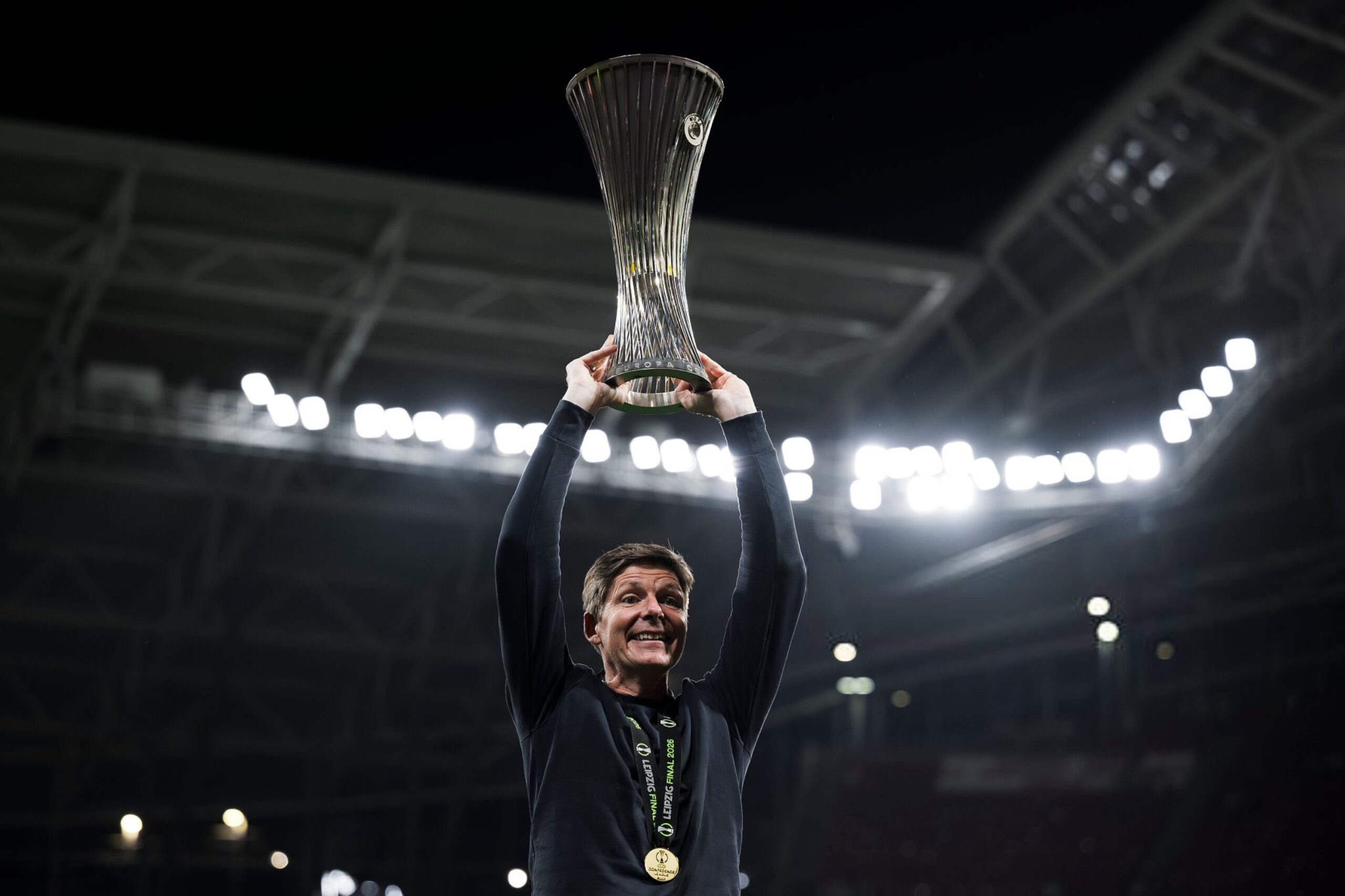

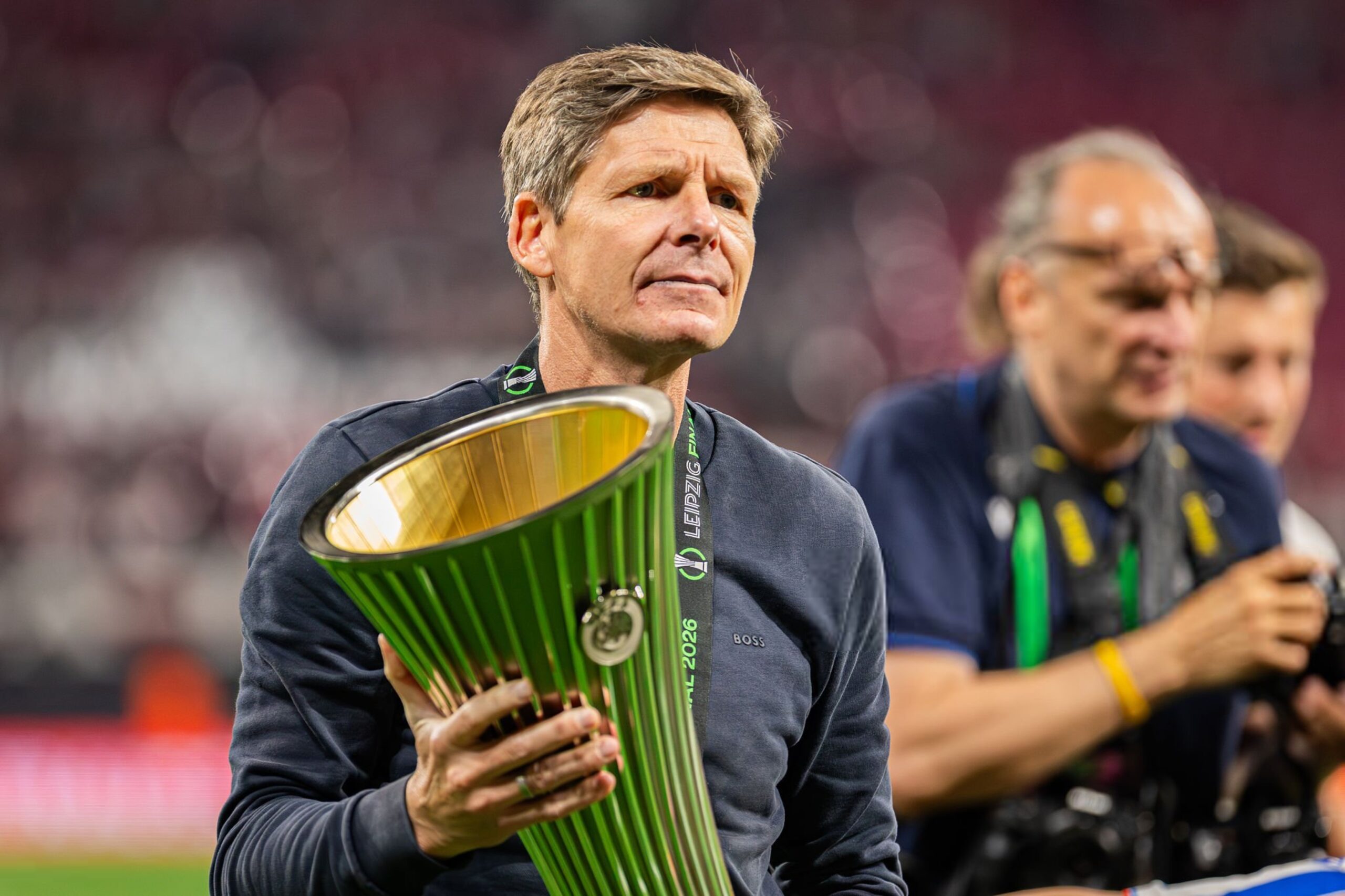
To understand the football of Oliver Glasner, one must start from a very simple idea that the coach himself embraces: formations matter, but they are not enough. The Austrian manager is often associated with the 3-4-2-1 system, a shape frequently used during his two and a half years at Crystal Palace, but reducing his football to the team’s starting structure would be misleading. Even in his relatively short Premier League spell, Glasner managed to bring solidity and strong performances to the Eagles, even before the results fully followed.
Glasner's teams must attack first, not wait:
Oliver Glasner’s football is built on a very clear foundation: intensity, aggression, and quick ball recovery. It is not slow, horizontal possession play, but rather a style that aims to win the ball in useful areas and attack immediately afterwards. This explains his consistent use of a back three system. With this setup, his teams can maintain a strong central presence thanks to a pair of central midfielders and two attacking midfielders (or high wide players) positioned narrowly behind the striker, all crucial roles for making his pressing effective, as relayed via those at Milan News.
That said, Glasner’s play does not remain centrally focused. Instead, it is channelled out wide, where it creates what are essentially “side traps”, as opponents are guided towards the flanks where they are more vulnerable. There, they are pressed by the wide player, the wide centre-back, who supports the build-up, and a central midfielder. This is where Glasner stands out: his pressing is not chaotic, but organised, with the team not simply running for the sake of it, but acting with a clear objective, namely the immediate recovery of the ball.
In possession, Glasner likes his teams to become compact before unleashing their full attacking power down the wings. The base, as mentioned, is often a 3-4-2-1 or a 3-4-3, with very high wing-backs, two narrow attacking midfielders operating between the lines, and a striker capable of playing both with his back to goal and in behind.
With his players, the Austrian coach does not seek possession for its own sake or aesthetic passing sequences. Instead, he wants the ball to move quickly in order to find the free man between the lines as soon as possible.
At Crystal Palace, for example, players such as Eberechi Eze (who later became a Premier League champion with Arsenal), Ismaïla Sarr, and Jean-Philippe Mateta (a name that could again come into fashion) were enhanced within a system built on direct attacking play, runs off the ball, and rapid transitions.
So, to summarise, Oliver Glasner is a pragmatic coach who organises, compacts, plays vertically, and demands intensity from his teams. He won the Europa League with Eintracht Frankfurt, proving he can build sides capable of beating theoretically stronger opponents.
However, The Guardian has also highlighted a sensitive point that should not be overlooked: his system, while very effective in transition-heavy contexts, can be much harder to translate into leagues where teams defend in a more compact, low block structure, such as Serie A.
For AC Milan, therefore, it would be an intriguing but complex choice, because Glasner would bring identity, pressing, and aggression, but he would also require the right players to make it work. He is not a magician, but a system-based coach.