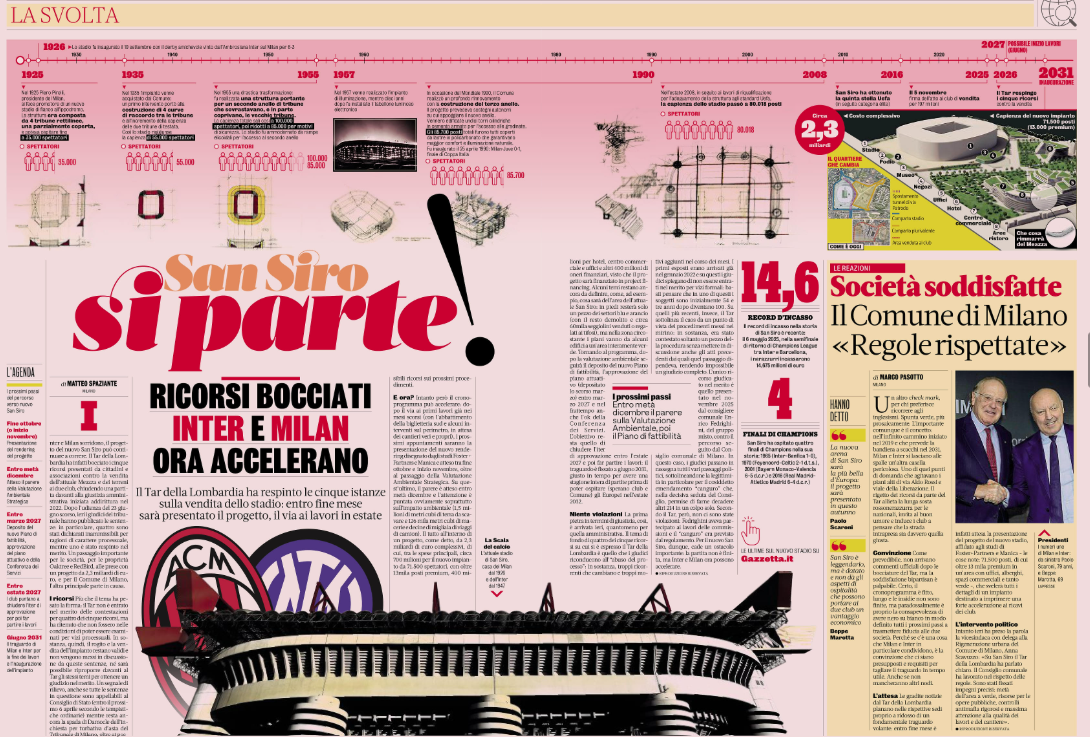


Inter and Milan are smiling: the new San Siro project can continue moving forward.
The Regional Administrative Court (TAR) of Lombardy has in fact rejected the five appeals filed by citizens and associations against the sale of the current Meazza stadium and the surrounding land to the two clubs, bringing to a close a case before the administrative courts that had begun as far back as 2022.
Following the hearing held on 23 June, the judges published their rulings yesterday: specifically, four appeals were declared inadmissible on procedural grounds, while one was rejected on its merits. This is an important step for the clubs, for their owners Oaktree and RedBird, which are working on a €2.3 billion project, and for the Municipality of Milan, the other main party in the case.
The appeals
Procedure mattered more than substance: the TAR did not examine the merits of the objections in four of the five appeals, but found that they could not be considered because of procedural defects. In practical terms, therefore, the deed of sale and the sale of the stadium remain valid and are not called into question by these rulings, nor will it be possible to bring the same issues before the TAR again in order to obtain a judgment on the merits. This is a significant development, although all the rulings in question can be appealed before the Council of State (by next 6 April under the ordinary time limits), while the investigation by the Milan Court into alleged bid-rigging still hangs over the matter like a sword of Damocles, in addition to possible appeals concerning future procedures.
And now?
In the meantime, however, the timetable can accelerate. Following the start of preliminary works in recent months, including the demolition of the south ticket office and some works around the perimeter, pending the launch of the actual construction sites, the next milestones will be the presentation of the new rendering designed by Foster + Partners and Manica, expected between the end of October and the beginning of November, as well as the Strategic Environmental Assessment process. With regard to the latter, the opinion is expected by mid-December, and attention is naturally focused above all on the environmental impact: 1.5 million cubic metres of soil to be excavated, 126,000 cubic metres of rubble, and tens of thousands of truck journeys.
All of this forms part of a project worth a total of €2.3 billion. Among the main costs are approximately €700 million for the new 71,500-seat stadium, including more than 13,000 premium seats; €400 million for hotels, a shopping centre and offices; and a further €400 million in financing costs, since the project will be financed through project financing. Some issues still remain to be defined, such as what will happen to the area occupied by the current San Siro. Only part of the blue and orange sectors will remain standing, while the rest will be demolished and around 60,000 seats will be sold or given away to supporters. As for the surrounding area, plans range from the construction of several buildings to the creation of an entirely green area.
Returning to the timetable, after the environmental assessment there will be the submission of the new feasibility plan, approval of the implementation plan (submitted last March) by March 2027, and, in the meantime, approval by the Conference of Services. The objective remains to complete the approval process by summer 2027 and then begin construction. The target completion date is June 2031, just in time to allow for a full season of matches before the stadium could host, as the clubs and the Municipality hope, matches during the European Championship in summer 2032.
No violations
The first milestone on the legal front therefore came yesterday, at least as far as administrative justice is concerned. The underlying issue in four of the five appeals ruled on by the Lombardy TAR is what the judges describe as an “abuse of process”: in essence, too many changes among the applicants and too many additional grounds being introduced over the course of the proceedings. The first complaints had already been filed in January 2022, and the judges explain that they did not examine their substance because of formal defects. In one of these cases, for example, the number of applicants initially stood at 54 and had risen to 100 three years later, as relayed via 'La Gazzetta dello Sport'.
As for the more recent appeals, the TAR highlighted the procedural confusion surrounding the measures being challenged. In essence, only one part of the procedure had been contested, without also challenging the earlier acts on which that stage depended, making it impossible for the court to carry out a complete assessment.
The only appeal examined on its merits was the one filed in November 2025 by city councillor Enrico Fedrighini, of the Mixed Group, against the procedure followed by Milan City Council. In this case, the judges reviewed the various political and procedural steps, stressing their lawfulness, particularly with regard to the so-called "kangaroo amendment," which, during the decisive City Council session, allowed another 214 amendments to lapse in a single move.
According to the TAR, however, there were no violations: Fedrighini had participated in the work of the committees, and the “kangaroo” mechanism was provided for under the Council’s rules of procedure.
For the new San Siro, therefore, a major obstacle has been removed. The matter is not yet over, but Inter and Milan can now move forward more quickly.