

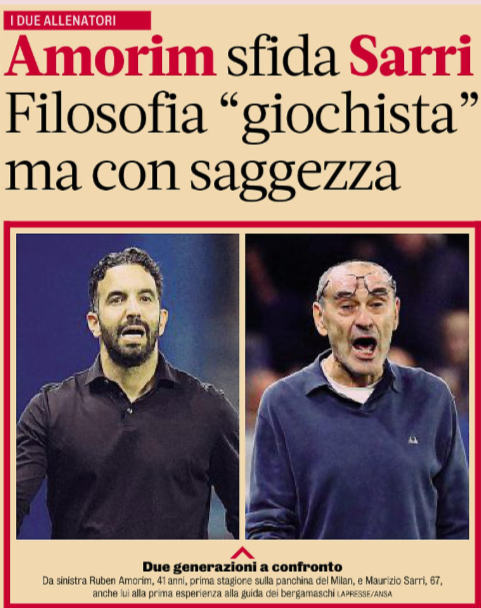
Faithful to the principle that a match must be controlled and directed, because they have never felt comfortable in the role of passengers. But they are not rigid fundamentalists; rather, they are intelligent enough to change their tactical approach to get the best out of the players at their disposal. Ruben Amorim and Maurizio Sarri face each other today for the first time: a generational clash in terms of age, but they are not so far apart in their ideas about football.
Amorim's Tactical Evolution: From Back Three to Back Four
Amorim was just beginning his coaching career at Casa Pia and Sporting Braga when Sarri was winning with Chelsea and Juventus. However, he must have sensed that, between the Premier League and Serie A, Sarri was also a model worth studying.
Two coaches who believe in attacking, possession-based football, each in his own way.
On the day of his presentation, the Rossoneri coach expressed himself as follows: "The number one objective is to dominate, to be a dominant team."
This does not mean keeping his head down and following only one path. For a start, he has switched from a back three to a back four. It is true that when Moreira plays at left-back, it is somewhat like defending with a 3+1 formation. But that is how it is.
The turning point came after the home defeat to Benfica in the Europa League. Before the international break, against Lecce, the new 4-4-2 formation appeared.
Since that match, Milan have recorded two victories and a draw, with the tactical system evolving into a 4-3-3.
It is too little to say that the right path has been found, but it can be said that, so far, the team has not rejected the change.
This is therefore a sign that Amorim is not a rigid ideologue.
How Amorim Has Transformed AC Milan's Attacking Play
Even in possession, he has softened certain rigid aspects of his approach. His attacking and aggressive style of play is no longer one-dimensional.
In Salzburg, we saw a team moving without giving their opponents fixed reference points. In this way, it becomes difficult to counter Amorim's tactical ideas.
Obviously, this requires a dynamic team, capable of being pragmatic in carrying out its tasks.
The two advanced central midfielders must exploit and illuminate spaces when they are without the ball, while the attacking wingers must not remain fixed to the touchline.
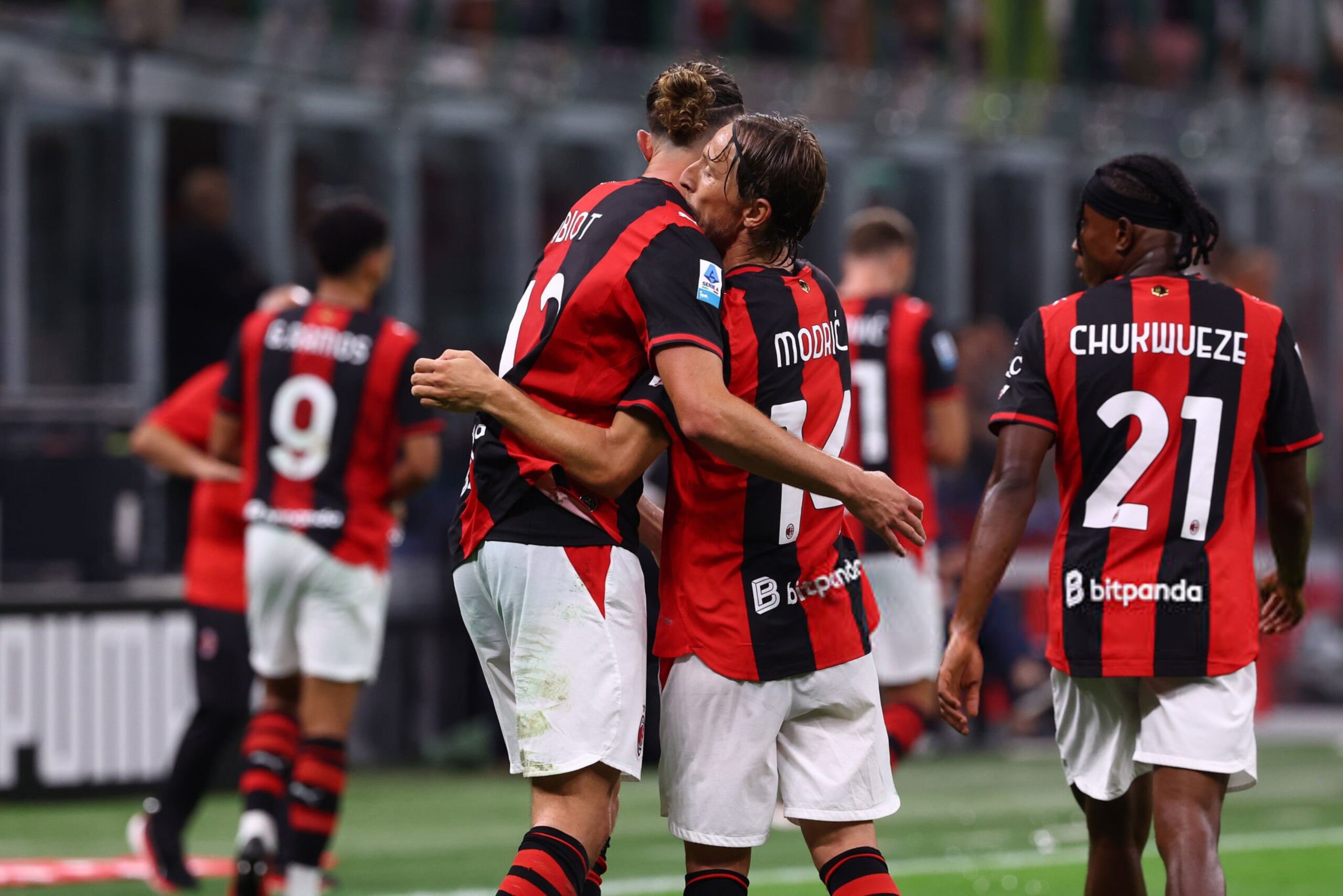
Samuel Chukwueze, protected by Gila operating as a right-back, is one of Amorim's tactical moves.
Luka Modrić, playing as the deepest midfielder, is the centre of gravity of this team, and with Yunus Musah alongside him, he has a supporting player capable of contributing in both the attacking and defensive phases, writes La Gazzetta dello Sport in this morning's print edition.
The knight is Adrien Rabiot, because his reading of the game is always interesting, and depriving him of his forward runs would be like changing his very nature.
In Manchester and Lisbon, Amorim liked to control possession, build from the back and attack down the wings.
To dominate, a team must have the physical condition and the technical qualities suited to its players.
But it is possible to remain a coach committed to proactive, possession-based football in this way too, even with a few more long balls and a little less intricate passing.
Sarri's Atalanta: From 4-3-3 to 4-2-3-1
Sarri, too, has shown that his footballing ideas are not set in stone.

The 4-3-3 formation used at the beginning of the season has been modified into a very fluid 4-2-3-1. Zonal defending remains the starting point, and this is where the most intensive work has been done with a group of players accustomed to playing with a back three for years.
Then Sarri's tactical rigidity gave way to the need to explore new solutions to make Atalanta more productive. Starting with Charles De Ketelaere, who has been positioned closer to the penalty area and the centre-forward, in a central role.
On the right, so far, we have seen Giacomo Raspadori for 20 minutes before his injury, and Eljif Elmas, whose versatility helps Sarri quickly switch to a three-man midfield. The principle of taking control of the match always remains, but without a deep-lying playmaker.
Gianluca Gaetano has been required more to disrupt the opposition's passing moves than to construct his own team's. Perhaps the 4-3-3 is not yet ready to be fully implemented in Bergamo.
AC Milan vs Atalanta: A Tactical Test at San Siro
But the 4-2-3-1 tells us that Sarri is ready to consider other tactical solutions. Today, amid an injury crisis, we will see which approach he chooses as he looks to secure a third consecutive victory.